


What Our Service Bay Team Wants You to Know About Diesel Maintenance and DPF Regeneration
Demystifying Modern Diesel Power and Performance
Modern diesel engines deliver incredible capability, but they require a different approach to maintenance than standard gasoline engines. Our service department helps drivers across Tennessee keep their heavy-duty trucks running at peak efficiency for years. If you are ready to bring your truck in, you can find our dealership location right off the main highway.
Many truck owners who commute from Tullahoma to the nearby Arnold Engineering Development Complex rely on the high-torque output of diesel power for their daily drives and weekend towing. To keep these advanced systems operating cleanly, we must understand the emissions components that make modern diesel so efficient. If you ever have a quick question about your engine’s performance, you can always give us a quick call to speak directly with an advisor.
Table of Contents
- Understanding DPF Regeneration and How Often It Occurs
- Essential Maintenance Schedule for the Ford 6.7L Power Stroke Engine
- Comparing Light Duty and Heavy Duty Diesel Commercial Truck Service
- Managing Long Term Diesel Ownership Costs and Emissions Diagnostics
- Why Professional Diesel Service Protects Your Investment
Understanding DPF Regeneration and How Often It Occurs
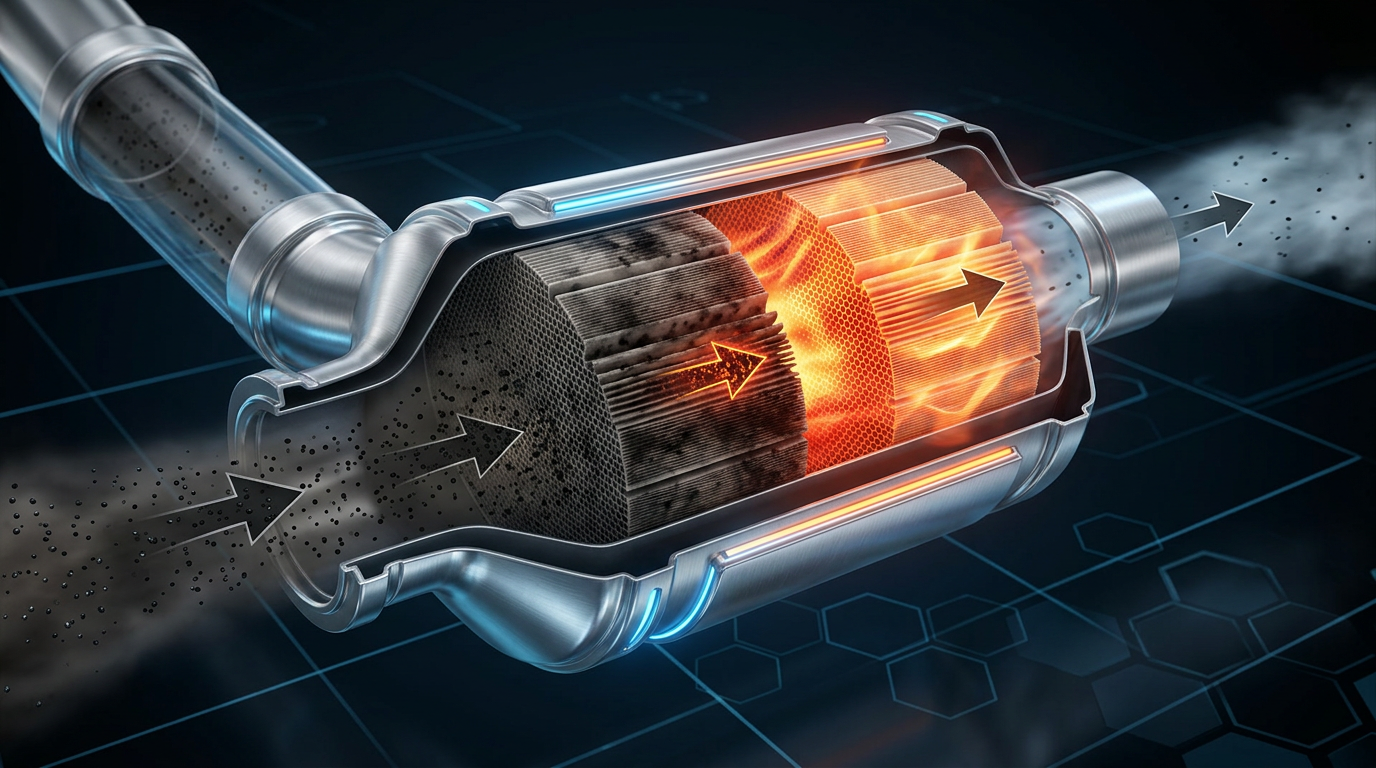
The diesel particulate filter, or DPF, captures soot from the exhaust to prevent black smoke from leaving the tailpipe. Over time, this soot builds up and must be burned off through a process called DPF regeneration. During active regeneration, the engine injects extra fuel to heat the exhaust system to roughly 1,100 degrees Fahrenheit, which safely converts the trapped soot into carbon dioxide.
During our service consultations, truck owners often ask how they can tell when their DPF is regenerating and how often it should happen. This self-cleaning cycle typically occurs automatically every 100 to 300 miles depending on how you drive your truck. Drivers looking for smaller, gasoline-powered alternatives for short city trips often browse our new Maverick selection to find a highly efficient daily driver.
When soot levels build up too high without a complete cleaning cycle, the truck may lose power or display a dashboard warning. If you are thinking about upgrading your current work truck to a fresher model, you can estimate your trade-in value online before visiting our lot. We also carry a wide variety of pre-owned diesel and gas trucks in our used vehicle inventory to fit any budget.
Essential Maintenance Schedule for the Ford 6.7L Power Stroke Engine
Maintaining a heavy-duty truck like the Ford Super Duty requires following a strict schedule to protect its highly engineered components. For the 6.7L Power Stroke diesel engine, Ford recommends replacing both the primary and secondary fuel filters every 15,000 miles to protect the high-pressure fuel pump from contamination. You should also check the water separator monthly and drain it as needed to keep moisture out of the fuel system.
At every 30,000 miles, the scheduled maintenance includes replacing the diesel fuel filter, replacing the engine air filter, and torquing the rear axle U-bolts to specification. When it is time for this critical milestone, you can easily schedule a service appointment with our factory-trained technicians. We use only OEM parts, such as the recommended Motorcraft FL-2051S oil filter, and high-quality SAE 5W-40 or 10W-30 synthetic blend oil meeting Ford specification WSS-M2C171-F1.
The maintenance schedule also calls for replacing the diesel foam air filter at 45,000 miles and flushing the engine coolant at 100,000 miles. Major fluid services, including the automatic transmission fluid and filter, rear axle fluid, and accessory drive belt replacement, occur at 150,000 miles. You can read more about these long-term milestones on our Newton Ford South blog or discover why choose Newton Ford South for your commercial and personal truck needs.
While the standard gasoline 7.3L engine on the King Ranch and Platinum trims delivers 430 hp and 485 lb-ft of torque through a 10-speed automatic transmission, many buyers choose the upgraded 6.7L Power Stroke diesel for heavy towing. The standard gas 6.8L engine on the Lariat, XL, and XLT trims produces 405 hp and 445 lb-ft of torque paired with the TorqShift-G 10-speed automatic.
### Engine & Performance *Powertrain specs by trim*
| Feature | King Ranch | Lariat | Platinum | XL | XLT |
|---|---|---|---|---|---|
| Engine | 7.3L | 6.8L | 7.3L | 6.8L | 6.8L |
| Horsepower | 430 hp | 405 hp | 430 hp | 405 hp | 405 hp |
| Torque | 485 lb-ft | 445 lb-ft | 485 lb-ft | 445 lb-ft | 445 lb-ft |
| Transmission | 10-speed automatic | TorqShift-G 10-speed automatic | 10-speed automatic | TorqShift-G 10-speed automatic | TorqShift-G 10-speed automatic |
| Drivetrain | Four-wheel Drive | Rear-wheel drive | Four-wheel Drive | Rear-wheel drive | Rear-wheel drive |
Comparing Light Duty and Heavy Duty Diesel Commercial Truck Service
Commercial operations require a clear understanding of the differences between light-duty and heavy-duty diesel service. Light-duty diesels, like those historically found in passenger trucks, feature compact emissions systems designed for mixed driving and standard highway commutes. You can explore our new vehicle inventory to see the latest light-duty options, including our highly capable new F-150 models.
Business owners managing fleets for local services near Spring Hill often find that heavy-duty commercial trucks require significantly larger fluid capacities and specialized heavy-duty components. For example, a heavy-duty diesel engine might require up to 15 quarts of oil compared to the smaller capacities of light-duty engines. Heavy-duty exhaust systems are also engineered for continuous, high-load operations, meaning they undergo different active regeneration patterns than light-duty passenger vehicles.
While our service department specializes in keeping heavy-duty work trucks on the road, we also cater to performance enthusiasts. If you are looking for pure track-ready power rather than commercial towing capability, you can view our new Mustang inventory to experience classic Ford performance. Understanding these distinct vehicle classes ensures you choose the right tool and the right maintenance plan for your specific goals.
Managing Long Term Diesel Ownership Costs and Emissions Diagnostics
Owning a diesel truck is a long-term investment that pays off in durability and extreme towing performance, but it requires careful financial planning. The initial cost of a heavy-duty truck varies by trim, with the entry-level XL starting at a base MSRP of $45,975 with a $2,795 destination charge, while the well-equipped XLT starts at a base MSRP of $49,175 with a $1,995 destination charge. For premium comfort and capability, the Lariat starts at $63,035 with a $2,795 destination charge, the King Ranch at $78,075 with a $2,795 destination charge, and the top-tier Platinum at $78,965 with a $2,795 destination charge.
To protect this investment, we utilize advanced electronic diagnostic tools to monitor emissions systems, including the DPF and Exhaust Gas Recirculation (EGR) components. Our technicians can read specific fault codes to pinpoint sensors that may be failing before they cause a costly breakdown. If you need replacement filters, sensors, or fluids to perform your own garage maintenance, our parts department can supply you with genuine OEM components.
For those who do not require the extreme towing capacity of our heavy-duty lineup, we also offer highly versatile midsize options. You can check out our new Ranger inventory for a maneuverable truck that fits easily into standard garages, or browse our new Super Duty inventory to find the ultimate commercial workhorse. Keeping up with routine diagnostics and using high-quality parts is the most effective way to minimize long-term operating costs.
### Pricing *Pricing by trim*
| Feature | King Ranch | Lariat | Platinum | XL | XLT |
|---|---|---|---|---|---|
| Base MSRP | $78,075 | $63,035 | $78,965 | $45,975 | $49,175 |
| Destination charge | $2,795 | $2,795 | $2,795 | $2,795 | $1,995 |
Why Professional Diesel Service Protects Your Investment
Entrusting your truck to certified professionals ensures that every component is serviced to exact manufacturer specifications. Our team has the specialized training and diagnostic software required to handle complex diesel systems, ensuring your vehicle remains reliable under heavy loads. If you are planning to purchase a new commercial vehicle or upgrade your personal truck, you can apply for financing online to streamline your buying process.
For added peace of mind on the road, every new Ford truck is backed by comprehensive warranty protection and emergency support. If you ever experience an unexpected issue or a flat tire while hauling a heavy load, you can contact Ford Roadside Assistance: 1-800-241-3673 for manufacturer-backed support. This service ensures your vehicle is towed directly to an authorized service center where technicians use only genuine parts to maintain your warranty.
Our dealership at 2811 US, Shelbyville, TN 37160 is fully equipped to handle all your diesel maintenance needs. Drivers can easily get directions to our showroom online. Please call our team at (931) 536-4424 to discuss how we can help protect your diesel investment.
© 2026 Newton Ford South. All rights reserved.
0 comment(s) so far on What Our Service Bay Team Wants You to Know About Diesel Maintenance and DPF Regeneration