


At What Mileage Milestone Does a Car’s Trade-In Value Drop the Most?
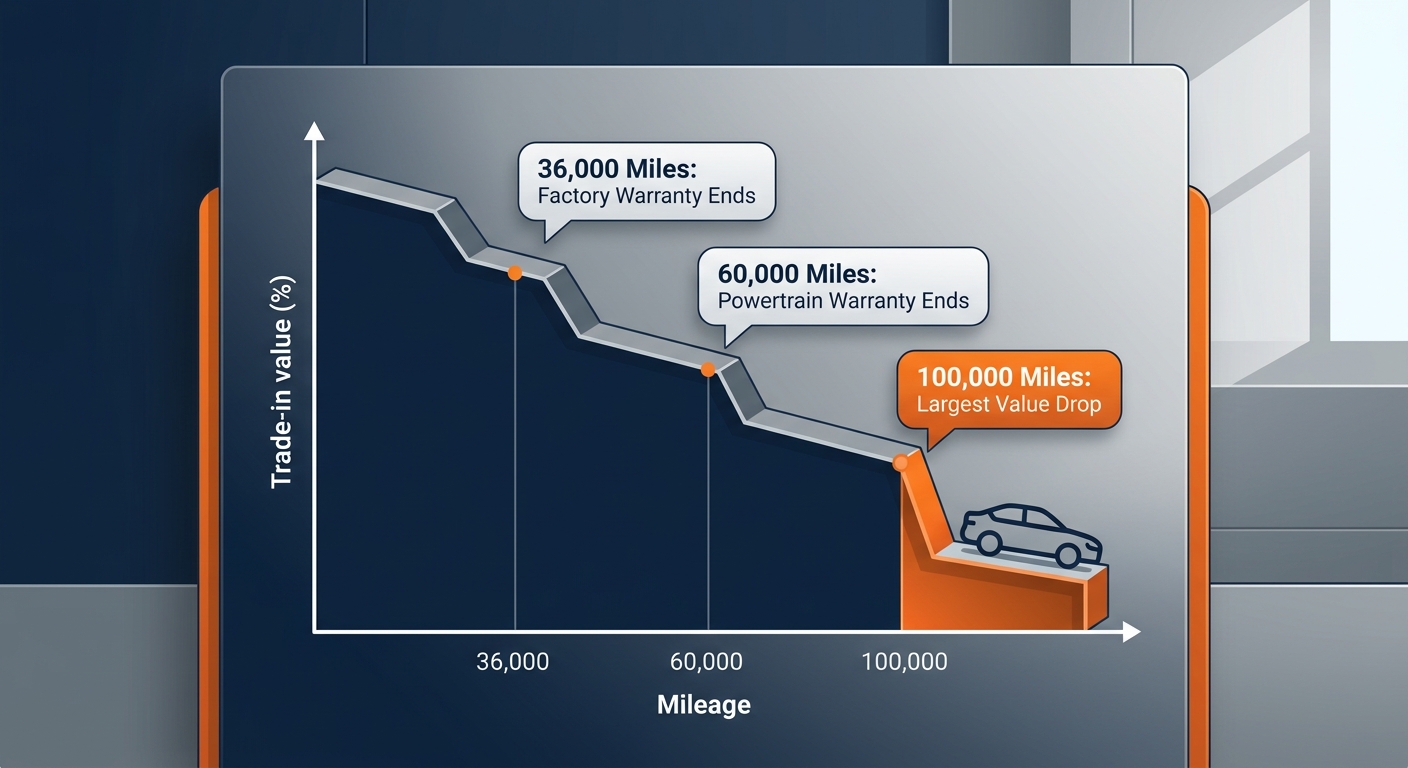
A vehicle’s trade-in value experiences its steepest drop after passing the 100,000-mile mark, where appraisal offers typically decline by 15% to 25% due to reduced retail buyer demand and upcoming major component maintenance. Secondary depreciation steps occur at 36,000 miles when factory bumper-to-bumper warranty coverage ends and at 60,000 miles when most powertrain warranty terms expire.
Understanding how odometer benchmarks affect wholesale values allows vehicle owners to time their upgrade strategically. Before hitting six figures on the odometer, a vehicle remains eligible for many prime used-car financing programs, making it significantly easier for a dealership to recondition and resell on the retail lot. Once an odometer crosses six figures, wholesale buyers and dealership appraisers factor in the heightened risk of mechanical wear on items such as suspension bushings, timing belts, and transmission components.
Depreciation does not follow a completely smooth line; it moves in distinct tiers tied to ownership milestones:
- 36,000 Miles: The original factory 3-year/36,000-mile bumper-to-bumper warranty expires. Buyers on the retail market pay a premium for vehicles covered against electrical and minor mechanical failures, so crossing this threshold creates the first noticeable value step.
- 60,000 Miles: The 5-year/60,000-mile powertrain warranty ends, coincided by major scheduled maintenance intervals like transmission fluid flushes, spark plug replacements, and brake service.
- 100,000 Miles: The psychological and financial boundary where retail demand drops sharply. Vehicles above this milestone are often diverted to wholesale auto auctions rather than retail lots, resulting in lower appraisal allowances.
Drivers commuting daily along the rolling terrain around Tullahoma often reach these mileage brackets faster than urban commuters. When evaluating a trade-in, acting right before one of these key mileage thresholds preserves significantly more equity. Drivers looking to evaluate their vehicle’s current market standing can easily check equity through an online trade-in appraisal tool, give our valuation desk a quick call at (931) 536-4424, or visit our Shelbyville showroom location for an in-person assessment.
Table of Contents
- Understanding Trade-In Value vs Private Party Value and Reconditioning Costs
- How Vehicle History Reports and Past Accidents Impact Your Appraisal
- How to Negotiate Your Trade-In Offer and Save Money on State Sales Tax
- Actionable Steps to Prepare Your Vehicle for Maximum Resale Value
- Common Questions About Vehicle Mileage Milestones and Trade-In Values
- Steps to Secure Your Highest Trade-In Offer
Understanding Trade-In Value vs Private Party Value and Reconditioning Costs
Trade-in value is the wholesale baseline a dealership offers to purchase a vehicle directly from an owner, which runs lower than private-party pricing because the dealer absorbs safety inspection fees, mechanical detailing, reconditioning expenses, and inventory holding risks before placing the car on the retail lot. Selling privately may yield a higher gross price on paper, but it requires personal time, advertising costs, managing test drives with strangers, and handling lien payoffs independently.
When a dealership receives a pre-owned vehicle, certified technicians perform a multi-point safety inspection. Reconditioning costs directly reduce the initial wholesale value calculation. Common reconditioning items include:
- Replacing worn tires to meet minimum tread depth safety standards.
- Resurfacing or replacing brake rotors and brake pads.
- Paint correction, dent repair, and interior steam cleaning.
- Completing overdue factory maintenance services and software updates.
Vehicle class and original equipment also shape baseline wholesale equity. For example, a full-size truck like the 2026 Ford F-150 King Ranch 4×4 SuperCrew 5-1/2’ Box with a base MSRP of $69,625 (plus a $2,595 destination charge) or an entry-level XL Regular Cab 8’ Box starting at $37,290 maintains strong resale demand due to work capability and towing utility. Similarly, versatile family haulers in our pre-owned vehicle inventory hold predictable value compared to niche sedans.
Shoppers comparing future trade-in retention often evaluate versatile models like the fuel-efficient Ford Maverick lineup or full-size options like the Ford Expedition options, as high-demand segments consistently command stronger wholesale bids when it comes time to trade up.
Pricing
Pricing by trim
| Feature | King Ranch 4×4 SuperCrew 5-1/2’ Box | King Ranch 4×4 SuperCrew 6-1/2’ Box | King Ranch SuperCrew 5-1/2’ Box | Lariat SuperCrew 5-1/2’ Box | Platinum 4×4 SuperCrew 5-1/2’ Box | Platinum 4×4 SuperCrew 6-1/2’ Box | Platinum SuperCrew 5-1/2’ Box | Police Responder 4×4 SuperCrew 5-1/2’ Box | Raptor 4×4 SuperCrew 5-1/2’ Box | STX 4×4 SuperCab 6-1/2’ Box | STX 4×4 SuperCrew 5-1/2’ Box | STX SuperCab 6-1/2’ Box | STX SuperCrew 5-1/2’ Box | Tremor 4×4 SuperCrew 5-1/2’ Box | XL 4×4 Regular Cab 6-1/2’ Box | XL 4×4 Regular Cab 8’ Box | XL 4×4 SuperCab 6-1/2’ Box | XL 4×4 SuperCrew 5-1/2’ Box | XL 4×4 SuperCrew 6-1/2’ Box | XL Regular Cab 6-1/2’ Box | XL Regular Cab 8’ Box | XL SuperCab 6-1/2’ Box | XL SuperCrew 5-1/2’ Box | XLT 4×4 SuperCab 6-1/2’ Box | XLT SuperCab 6-1/2’ Box |
|---|---|---|---|---|---|---|---|---|---|---|---|---|---|---|---|---|---|---|---|---|---|---|---|---|---|
| Base MSRP | $69,625 | $69,930 | $65,825 | $59,560 | $72,600 | $72,905 | $68,800 | $52,350 | $79,005 | $48,655 | $51,070 | $44,855 | $47,190 | $64,915 | $44,345 | $42,305 | $45,400 | $47,820 | $50,475 | $39,330 | $37,290 | $41,600 | $43,935 | $49,495 | $45,695 |
| Destination charge | $2,595 | $2,595 | $2,595 | $2,595 | $2,595 | $2,595 | $2,595 | $2,595 | $2,595 | $2,595 | $2,595 | $2,595 | $2,595 | $2,595 | $2,595 | $2,595 | $2,595 | $2,595 | $2,595 | $2,595 | $2,595 | $2,595 | $2,595 | $2,595 | $2,595 |
How Vehicle History Reports and Past Accidents Impact Your Appraisal
A vehicle history report directly alters an appraisal offer, as a documented accident history, frame repair, or title blemish can reduce trade-in value by 10% to 30% regardless of how expertly the bodywork was completed. Modern appraisers pull detailed VIN reports to verify odometer records, ownership transfers, open recalls, and structural damage reports.
Even minor fender benders reported to insurance companies or law enforcement generate a entry on history reports. Appraisers adjust valuations based on three severity levels:
- Minor Cosmetic Incidents: Scratches or bumper repairs that required no structural work typically result in minor deductions of 5% to 10%.
- Moderate Accidents: Damage requiring panel replacement or airbag deployment reduces value by 15% to 20% due to diminished resale appeal.
- Structural or Frame Damage: Major collision repairs or branded titles (such as salvage or rebuilt) lower trade-in offers by 30% to 50%, as most franchised dealers cannot sell these on retail lots.
Having complete service records from an authorized service center helps offset higher odometer readings or minor historical notes. Consistent oil changes, fluid flushes, and genuine factory parts replacement prove responsible ownership. If your current ride needs minor maintenance or genuine components prior to an appraisal, ordering factory parts through our Ford parts department ensures fitment and quality. Exploring options in our new vehicle inventory or checking out the new Ford F-150 lineup gives you a clear target for how much equity you need to bridge your next purchase.
How to Negotiate Your Trade-In Offer and Save Money on State Sales Tax
Negotiating a trade-in offer relies on bringing documented local market valuation estimates, and trading in at a dealership provides a substantial tax offset because Tennessee sales tax applies only to the net price difference between your new vehicle purchase and your trade-in allowance. This state tax credit effectively narrows or closes the gap between wholesale trade-in offers and private-party listing prices.
Consider a practical mathematical scenario when upgrading your vehicle:
- New Vehicle Purchase Price: $40,000
- Dealership Trade-In Allowance: $15,000
- Taxable State Amount: $25,000 ($40,000 minus $15,000)
- State Sales Tax Saved (at 7% base rate): $1,050 in direct tax savings
To negotiate your appraisal effectively, research current retail listings for similar year, make, and mileage vehicles in your region. Present recent service receipts to show meticulous care. Local drivers hauling horse trailers or equipment across Shelbyville benefit from taking care of scheduled maintenance before appraisal day. Bringing your maintenance history completely up to date by choosing to schedule a maintenance check helps clear minor diagnostic codes or service lights that might otherwise trigger reconditioning deductions.
Leveraging tax credits makes transitioning into mid-size utility vehicles like new Ford Ranger models or three-row family vehicles like the new Ford Explorer lineup far more budget-friendly than buying outright without a trade.
Actionable Steps to Prepare Your Vehicle for Maximum Resale Value
Maximizing trade-in equity requires thorough cabin detailing, gathering all service documentation, fixing minor cosmetic issues, keeping original factory equipment intact, and ensuring all keys and floor mats remain with the vehicle. Presenting a clean, well-documented vehicle allows the appraiser to focus on its actual quality rather than budgeting extra cushion for unknown repairs.
Follow this simple preparation checklist before driving to the dealership:
- Clean out all personal belongings, glovebox clutter, and trunk cargo.
- Wash the exterior and vacuum carpets, seating surfaces, and cargo bays.
- Collect all original accessories, including spare tire tools, owner manuals, extra key fobs, and cargo covers.
- Gather all paper maintenance invoices or print out an electronic service history summary.
- Avoid low-quality aftermarket modifications, as non-factory wheels or suspension lifts often narrow the resale target market and lower wholesale appraisal value.
Keeping factory specifications intact preserves utility and buyer confidence. For instance, a 2026 Ford F-150 King Ranch SuperCrew 5-1/2’ Box maintains a standardized about 53 cu ft cargo volume, a curb weight of 5,096 lbs, a payload capacity of 1,945 lbs, and a maximum towing capacity of 10,400 lbs. Altering factory suspension or tow hitches can complicate trade valuations.
Once your trade preparation is complete, getting pre-approved through our online credit application lets you calculate exact monthly targets for modern electric options like Ford F-150 Lightning models or rugged off-road vehicles like the new Ford Bronco lineup.
Fuel Economy
Fuel economy and range by trim
| Feature | King Ranch 4×4 SuperCrew 5-1/2’ Box | King Ranch 4×4 SuperCrew 6-1/2’ Box | King Ranch SuperCrew 5-1/2’ Box | Lariat SuperCrew 5-1/2’ Box | Platinum 4×4 SuperCrew 5-1/2’ Box | Platinum 4×4 SuperCrew 6-1/2’ Box | Platinum SuperCrew 5-1/2’ Box | Police Responder 4×4 SuperCrw 5-1/2’ Box | Raptor 4×4 SuperCrew 5-1/2’ Box | STX 4×4 SuperCab 6-1/2’ Box | STX 4×4 SuperCrew 5-1/2’ Box | STX SuperCab 6-1/2’ Box | STX SuperCrew 5-1/2’ Box | Tremor 4×4 SuperCrew 5-1/2’ Box | XL 4×4 Regular Cab 6-1/2’ Box | XL 4×4 Regular Cab 8’ Box | XL 4×4 SuperCab 6-1/2’ Box | XL 4×4 SuperCrew 5-1/2’ Box | XL 4×4 SuperCrew 6-1/2’ Box | XL Regular Cab 6-1/2’ Box | XL Regular Cab 8’ Box | XL SuperCab 6-1/2’ Box | XL SuperCrew 5-1/2’ Box | XLT 4×4 SuperCab 6-1/2’ Box | XLT SuperCab 6-1/2’ Box |
|---|---|---|---|---|---|---|---|---|---|---|---|---|---|---|---|---|---|---|---|---|---|---|---|---|---|
| MPG | 16 city / 24 hwy / 19 combined | 16 city / 24 hwy / 19 combined | 17 city / 25 hwy / 20 combined | — | 16 city / 24 hwy / 19 combined | 16 city / 24 hwy / 19 combined | 17 city / 25 hwy / 20 combined | — | 14 city / 18 hwy / 16 combined | 18 city / 23 hwy / 20 combined | 18 city / 23 hwy / 20 combined | 19 city / 25 hwy / 21 combined | 19 city / 25 hwy / 21 combined | 15 city / 20 hwy / 17 combined | 16 city / 24 hwy / 19 combined | 18 city / 23 hwy / 20 combined | 18 city / 23 hwy / 20 combined | 18 city / 23 hwy / 20 combined | — | 16 city / 24 hwy / 19 combined | 19 city / 25 hwy / 21 combined | 19 city / 25 hwy / 21 combined | 19 city / 25 hwy / 21 combined | 18 city / 23 hwy / 20 combined | 19 city / 25 hwy / 21 combined |
Common Questions About Vehicle Mileage Milestones and Trade-In Values
Q: Does crossing 100,000 miles automatically ruin a car’s trade-in value?
Crossing 100,000 miles does not ruin a vehicle’s value, but it does shift its valuation into a lower wholesale tier. Dealerships evaluate high-mileage trades based on overall mechanical condition, frame integrity, and local market demand. A well-maintained vehicle with documented service records at 105,000 miles can easily command a stronger trade-in offer than a neglected vehicle with 85,000 miles.
Q: Is it better to repair body damage before trading in a car?
Minor cosmetic fixes like thorough cleaning or buffing out light paint scratches are cost-effective, but major body repairs are rarely worth paying for out-of-pocket before a trade. Dealerships complete bodywork and mechanical repairs at internal wholesale labor and parts rates, which cost significantly less than retail body shop estimates.
Q: Can I trade in a vehicle if I still owe money on my auto loan?
You can trade in a vehicle with an active auto loan. The dealership contacts your lender to obtain an official payoff quote. If your trade-in allowance exceeds the loan payoff, the remaining positive equity applies directly toward your down payment. If you owe more than the trade offer (negative equity), the remaining balance can often be rolled into your new vehicle financing structure.
Q: Why are trade-in offers lower than online retail listing prices?
Online retail prices represent the final cost a consumer pays after a dealership inspects, repairs, details, warranties, and advertises a vehicle. The trade-in offer reflects wholesale market value minus the estimated reconditioning expenses and financial risk the dealer assumes while holding the inventory on the lot.
Q: How do custom aftermarket parts affect trade-in offers?
Custom aftermarket parts like oversized wheels, exhaust modifications, or aftermarket stereo systems generally decrease trade-in value. Dealerships prefer factory-original specification vehicles because they appeal to a wider audience of retail buyers and meet factory safety standards without voiding warranty terms.
For drivers looking to learn more about our process, you can learn more about our team, explore performance models like the new Ford Mustang inventory, or experience advanced electric utility with the Ford Mustang Mach-E selection.
Steps to Secure Your Highest Trade-In Offer
Getting the highest trade-in offer for your vehicle comes down to timing your trade before major mileage milestones, maintaining thorough service documentation, and taking advantage of state sales tax savings. Whether your vehicle is approaching 36,000 miles, 60,000 miles, or 100,000 miles, evaluating your equity early ensures you make a well-informed financial move.
Our team provides transparent physical appraisals and simple trade-in consultations designed to fit your schedule. Take the next step today by starting your valuation online, giving us a quick call at (931) 536-4424, or coming by to visit our local dealership to explore heavy-duty capability like our new Ford SuperDuty trucks today.
0 comment(s) so far on At What Mileage Milestone Does a Car’s Trade-In Value Drop the Most?