You Are Here : Home >> 2022 Ford F-150 vs 2022 Toyota Tundra
2022 Ford F-150 vs 2022 Toyota Tundra
2022 Ford F-150
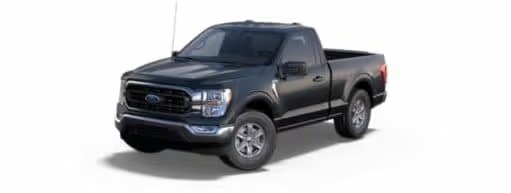
Starting at
$30,495[a]

2022 Toyota Tundra
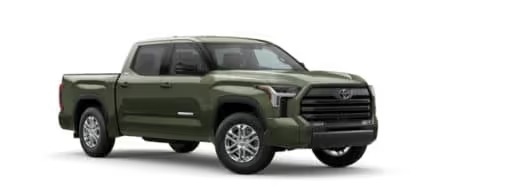
Starting at
$35,950
14,000
Max Towing (lbs)
12,000
3,325
Max Payload (lbs)
1,940
290-450
Horsepower (hp)
348-437
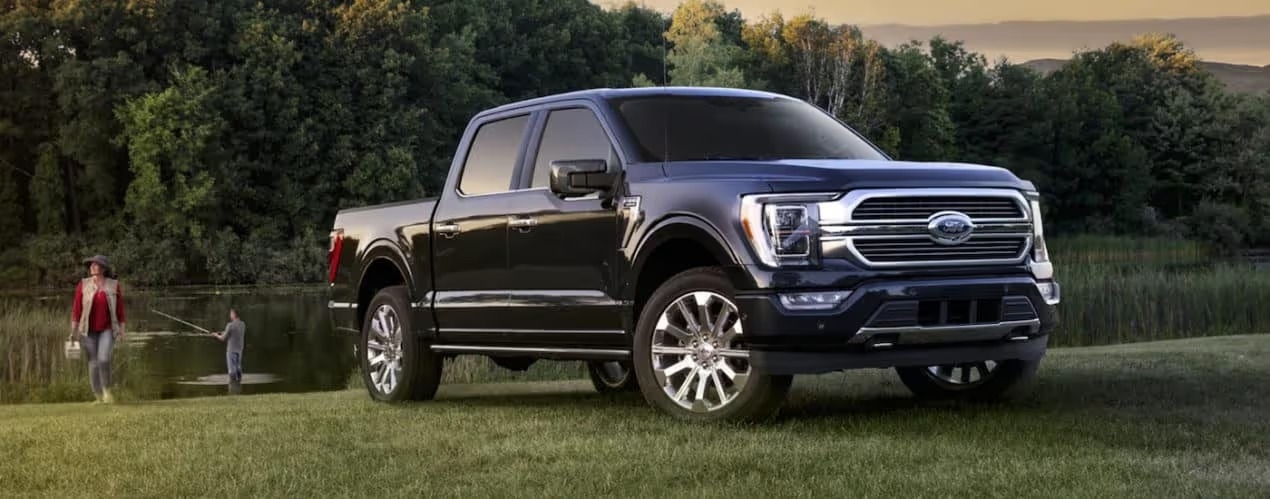
Truck drivers want more than just a vehicle – they want a capable machine that doesn’t leave work unfinished. With so many options to choose from, how do you know which vehicle is the right one? The 2022 Ford F-150 isn’t the underdog by any means, but it faces the popular 2022 Toyota Tundra, which interestingly falls flat in more categories than you may have thought. After all, there’s something to be said when a pricier pickup truck is stacked up against both a cheaper and more powerful competitor, and the 2022 Ford F-150 vs 2022 Toyota Tundra is proof of this.
Not only is the F-150 pickup truck the best-selling pickup in the United States, but it’s the best-selling vehicle altogether. This title has been earned through multiple decades of continuous production and undeniable quality. On the other end, the 2022 Toyota Tundra is no slouch, with ample performance complemented by the legendary Toyota badging. While these pickups are decently capable when looked at solely, comparatively, these two trucks are worlds apart.
The 2022 F-150 starts at an MSRP of $30,495, and the 2022 Tundra starts at a much higher MSRP of $35,950.[a] This is the first major downfall of the Tundra, as a starting price that sits $5,000 over the base F-150 isn’t something to take lightly. Customers looking to capitalize on the latest base-level experience will be instantly drawn to the F-150 XL, even if its performance isn’t on par with the base Tundra. However, there’s no shortage of choice, thanks to eight available F-150 trims if you include the Raptor and seven available Tundra trims.
Performance
There’s plenty of performance between the F-150 and Tundra, but there are significantly more options on the F-150. As an additional bonus, the F-150 can outmatch the Tundra in towing capacity, which is something that most, if not all, potential shoppers will care about. Beginning with the base engines, the F-150 does fall short of performance, but then again, for a vehicle that costs $5,000 less, it’s not a terrible sacrifice to make. It’s also worth noting that every F-150 vehicle, much like every Tundra, pairs its engines to a 10-speed automatic transmission for peak performance.
Comparing All the Performance Options
The base F-150 engine is a 3.3L V6 that creates 290 hp and 265 lb-ft of torque, and the base Tundra features a 3.5L i-FORCE Turbocharged V6 that creates between 358 and 389 hp and between 405 to 479 lb-ft of torque. This would be an issue if it weren’t for two major caveats: the base Tundra, again, costs $5,000 more, and there are four other engines to select from with the F-150 against the Tundra’s one other powertrain.
The second powertrain for the Tundra is the hybrid variant of the V6, which the F-150 matches with its 3.5L hybrid V6. And, while the hybrid Tundra outputs 437 hp and 583 lb-ft of torque against the F-150’s 430 hp and 570 lb-ft of torque, this Tundra hybrid powertrain can only tow 11,450 lbs against the F-150 hybrid’s 12,700 lbs.
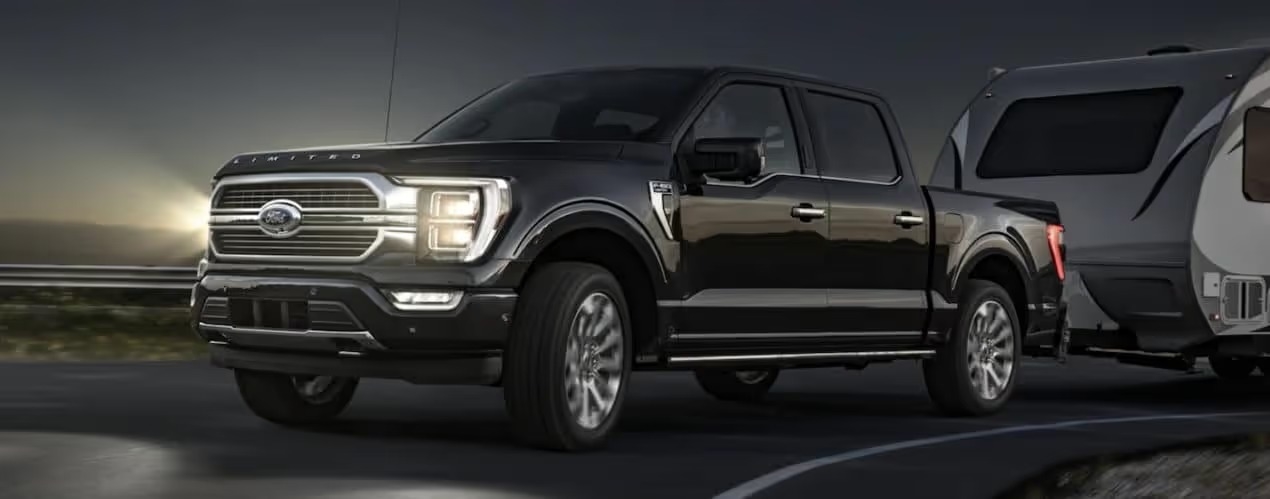
Although the hybrid F-150 produces impressive results, it complements its non-hybrid 3.5L V6 sibling. This non-hybrid 3.5L V6 engine sports 400 hp and 500 lb-ft of torque, with the F-150’s highest maximum towing capacity of 14,000 lbs, which is 2,000 lbs more than the Tundra’s 12,000 lbs maximum. So, if you’re looking for the best towing performance out of the bunch, the turbocharged 3.5L V6 for the F-150 is the way to go.
If you’re more interested in a V8, then you’ll be pleased to know the F-150 allows for the famous 5.0L V8 engine dubbed “Coyote.” Thanks to the Coyote, the F-150 can support a maximum payload capacity of 3,325 lbs, which stomps on the Tundra’s maximum of 1,940 lbs. There’s no such engine for the Tundra, which is a devastating blow for shoppers looking for a V8 and will instead draw them to the cheaper F-150. That’s not all for the F-150, though, because there’s still the turbocharged 2.7L V6, which has the best gas-only engine fuel-saving capabilities out of the bunch with its EPA-estimated ratings of 20 MPG in the city and 26 MPG on the highway.
Interior
Looking at the Space Available in Each Truck
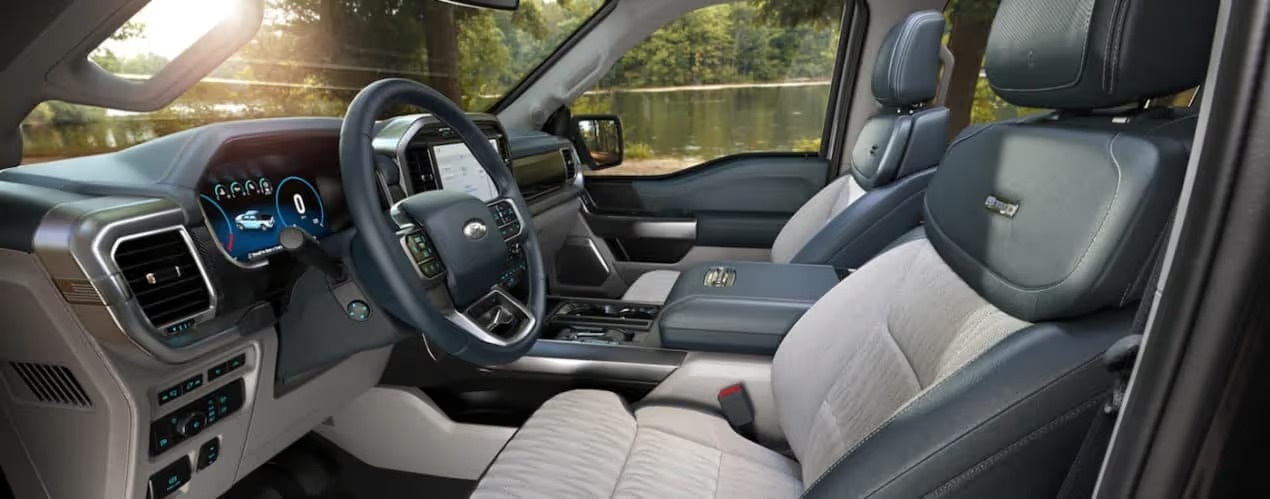
Both Ford and Toyota are well regarded for their interiors, but between the F-150 and Tundra, Ford’s vehicle is both more feature-packed and occasionally more spacious too. Both the F-150 and Tundra will seat between three to six passengers, depending on which cab size you’ve purchased. The dimensions of the Tundra and F-150 will also vary depending on the cab size that you’ve opted for, but at their most spacious, the F-150 offers front-row occupants 40.8 inches of headroom against the Tundra’s 41 inches. However, the Tundra’s 41.2 inches of front-row legroom is outshined by the F-150’s 43.9 inches, and the rear-row legroom is also more generous than the F-150, with 43.6 inches against 41.6 inches. And the F-150 also has more rear-row headroom, with 40.4 inches compared to the Tundra’s 38.5 inches. All things considered, passengers are going to fit better within the F-150, which may be a crucial selling point, depending on what you need your truck to do.
Cargo space is also highly comparable between the two trucks, and that’s because all three of the bed sizes are nearly identical, save for one difference. The available bed sizes are as follows: 5’5”, 6’5”, and the Tundra has a slightly larger 8’1” bed against the F-150’s 8’0” bed. That extra inch of space isn’t going to make or break your decision, but it’s good to know that the F-150 doesn’t fall too short against the Tundra in this regard. And, thanks to the far better payload capacity of the F-150, you’ll be carrying more than the Tundra allows for anyways.
Now, Which One Offers More Tech?
Some of the tech-based features are also highly comparable between the two trucks, and the same goes for the style of seats both manufacturers use. For example, manually-adjustable driver’s seats come standard, but these can be swapped out for an 8-way power-adjustable seat on either vehicle, depending on the trim that you purchase. Not just that, but both the F-150 and Tundra can also be fitted with 10-way power-adjustable seats, and the cloth stitching found in both trucks can be replaced with genuine leather.
As for the tech-based features that you’ll find – both trucks come standard with infotainment centers that can be upgraded to feature larger screens. Both base-level infotainment centers come with 8-inch screens, although the F-150 maxes out with a 12-inch screen against the Tundra’s 14-inches. The two inches of screen real estate won’t be much of an inconvenience, if at all, since you’ll still have all of the screen room you’d need to navigate through menus and use apps effectively. Speaking of the apps, both trucks feature Apple CarPlay and Android Auto, which allows you to connect your smartphone to either of these two trucks. That’s not to say the multimedia experience is identical because the F-150 can be fitted with an 18-speaker premium audio system from Bang & Olufsen, which has ⅓ more speakers than the Tundra’s 12-speaker audio solution by JBL.
Safety
Safety, in both design and technology, can make or break a vast majority of a truck’s general appeal. If your truck looks menacing on the outside, but can easily fall apart when damaged, then your truck’s looks are more deceptive than anything else. The IIHS (Insurance Institute for Highway Safety) measures a vehicle’s durability through an array of safety tests, including a host of collision experiments. Where the Tundra falters significantly – having earned a variety of mediocre ratings in the testing – the 2022 F-150 has earned the IIHS’ Top Safety Pick as a result of more successful results during its testing.
Which of These Models Can You Trust Most?
Both the F-150 and Tundra come with a host of safety features implemented into safety packages that come standard with the two trucks. The F-150 comes with the Ford Co-Pilot 360 safety package, and the Tundra comes with Toyota Safety Sense 2.5. Many of the features found on one package are present on the other, including the Pre-Collision Assist system on the F-150, which is matched by the Pre-Collision System with Pedestrian Detection on the Tundra.
Other safety features that you can expect to find on both standard packages include a Lane-Keeping System on the F-150 that will correct any misalignment with your lane when traveling on the freeway, and the Tundra has the same capabilities found in the Lane Departure Alert with Steering Assist. And, among other features such as Rear-Cross Traffic Alerts on both vehicles, you can opt for Intelligent Adaptive Cruise Control with the F-150 or Full-Speed Range Dynamic Radar Cruise Control with the Tundra. Although both trucks are comparable in the safety features, standard or otherwise, the F-150 is undoubtedly the more sturdy truck and the cheaper one too. Safety should be a primary concern for any type of automobile that you purchase, and fortunately, the F-150 surpasses expectations in many ways.
🛈 Newton Ford South Is Where You Should Go for Your Next Truck
Excitement is in the air at Newton Ford South because we not only have the best pricing in the greater area of Shelbyville, TN, but we’ve also got one of the best selections of new Ford vehicles around. Everyone loves Ford, and everyone loves great deals, so when you combine the two along with a genuine and enjoyable shopping experience, you can see why Newton Ford South is the dealership that you should visit.
Our staff knows more about these Ford vehicles than anyone, and we’ll be happy to share our thoughts with you on what kind of vehicle would suit your needs as a driver. Our dealership also includes an on-site service center, and if you need your vehicle promptly fixed, then you can trust our group of certified technicians. Come on down today and check out our new Ford trucks and find the model that is perfect for you.
[a]MSRP may change without notice. See dealer for complete details.
MSRP excludes tax, license, registration, additional options, and possible destination charges. Dealers set own prices.