Why Is Trade-In Value Usually Lower Than What Dealers Sell the Car For Later?
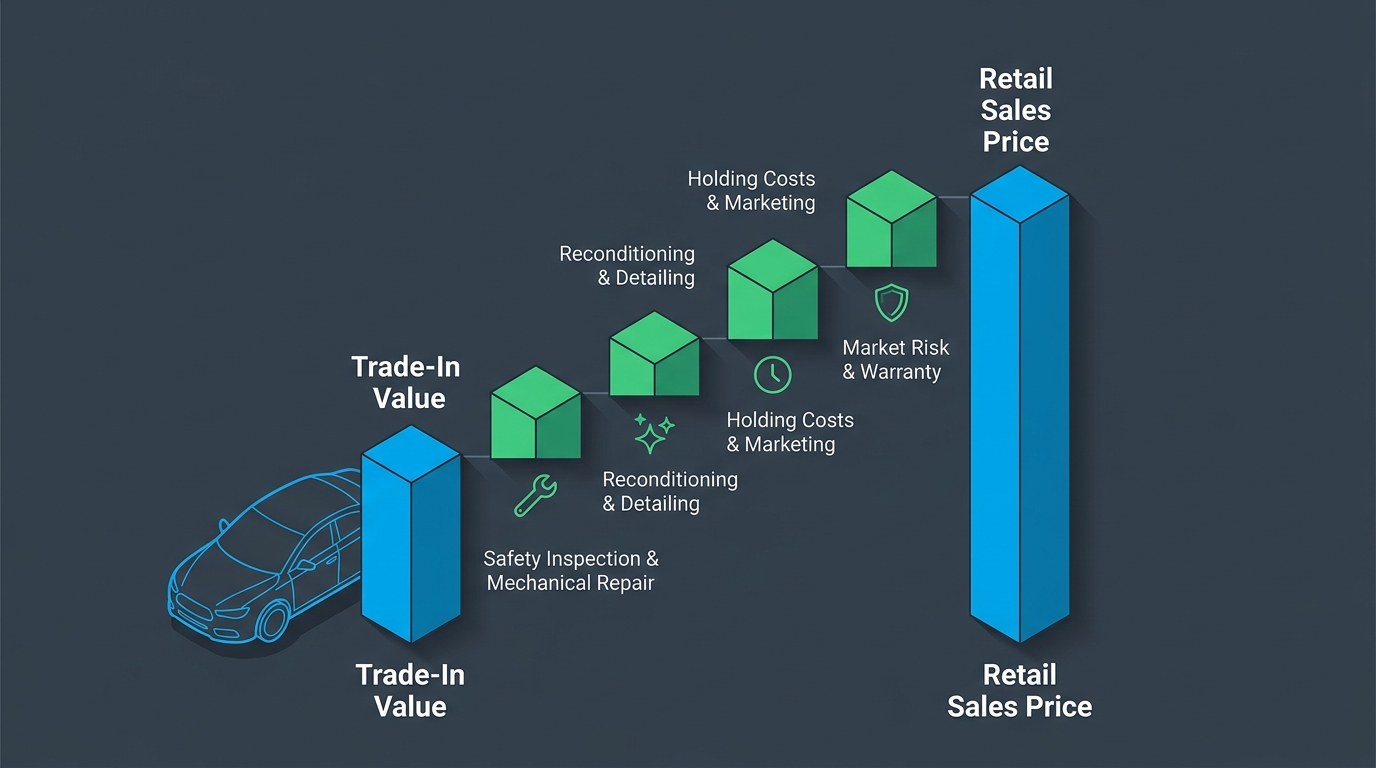
Trade-in value is lower than a dealership's later retail asking price because dealers must invest significant capital to inspect, repair, recondition, and market every acquired vehicle to meet safety and retail standards. Between reconditioning expenses, extended warranty backing, floor plan financing, and operational overhead, the price spread allows the dealership to absorb resale risks while providing you with an immediate, hassle-free credit toward your next vehicle.
When you bring a pre-owned vehicle to a dealership, the offer you receive reflects wholesale market conditions rather than the final sticker price on a retail lot. Before a traded vehicle can be parked on a front line and offered to a buyer, it must undergo a rigorous safety and mechanical evaluation. Certified technicians check critical components, including braking systems, tire tread depth, suspension parts, fluid levels, and exhaust systems. Any identified defects must be repaired using quality parts and skilled labor, which creates a substantial baseline cost for the dealer.
Beyond direct mechanical repairs, a dealership incurs administrative, reconditioning, and holding expenses. Professional interior and exterior detailing, paint correction, windshield replacement, and wheel refinishing are frequently necessary to restore a vehicle to retail-ready condition. Once reconditioned, the vehicle carries operational holding costs while sitting in inventory, including floor plan interest rates, insurance fees, and digital marketing advertising.
The price markup between wholesale acquisition and retail listing also shields the dealership against unpredictable used-market depreciation and unexpected mechanical failures during the warranty period. If a traded car sits on the lot for several weeks during a market downturn, its retail value may drop, squeezing those profit margins. When local drivers ask our appraiser why an estimate differs from listed online sales prices, we walk them through our multi-point inspection checklist to show the exact repairs and reconditioning required before a vehicle reaches our lot.
Trading in your vehicle eliminates those exact risks and financial burdens for you as the seller. Rather than managing reconditioning costs out of pocket, waiting weeks for a private buyer, and handling buyer warranty disputes later, a trade-in delivers immediate liquid credit toward your upgrade. If you want a clear look at how our appraisal process works, feel free to drop by our Shelbyville showroom at 2811 US, Shelbyville, TN 37160 or give our team (931) 536-4424 to speak with an appraiser directly.
Table of Contents
- What Is the Difference Between Trade-In Value, Private-Party Value, and Dealer Retail Value?
- Why Is Trade-In Value Lower Than Private-Party Value?
- Does Vehicle Type, Local Demand, and Mileage Impact Trade-In Value?
- Will Detailing and Pre-Appraisal Prep Increase Your Car's Trade-In Value?
- What Information and Paperwork Should You Bring to Negotiate a Better Offer?
- How Does Trading In Your Vehicle Reduce the Amount You Need to Finance?
- Frequently Asked Questions About Car Trade-Ins
- Take the Next Step Toward Maximizing Your Trade Value
What Is the Difference Between Trade-In Value, Private-Party Value, and Dealer Retail Value?
Trade-in value represents the wholesale credit a dealership offers toward your purchase, private-party value is the peer-to-peer price negotiated directly between individual buyers and sellers, and dealer retail value is the final lot price after full reconditioning, multi-point inspection, and dealer warranty coverage. Understanding these three pricing tiers helps you set realistic financial expectations when upgrading your vehicle.
Trade-in value sits at the foundation of vehicle pricing structure. It is designed to reflect the net wholesale worth of a car in its current, untouched state. Because the purchasing dealership absorbs all upcoming maintenance, cosmetic work, title transfers, and resale overhead, trade-in valuations are typically lower than private sale or retail numbers. However, trading in offers maximum convenience, instant payment, and valuable sales tax offsets in many states.
Private-party value represents the middle tier in the automotive market. This is the amount a private buyer might pay an individual seller in a direct transaction. While private-party prices are generally higher than trade-in offers, the seller must take on full responsibility for the sales process. This includes taking photos, publishing advertisements, answering messages, arranging test drives with strangers, verifying cashiers' checks, and coordinating title transfers at the county clerk's office.
Dealer retail value occupies the highest tier in vehicle valuation. This is the listed price you see on window stickers when browsing a dealership's pre-owned lot. Retail pricing accounts for the complete investment made into the vehicle, including comprehensive mechanical restoration, fresh tires or brakes, cosmetic detailing, state safety inspections, and vehicle history reports. Furthermore, retail vehicles often come backed by dealer protection plans or certified warranty coverage, providing long-term peace of mind that private sellers simply cannot offer. If you are curious where your current car stands relative to market trends, exploring our pre-owned inventory selection provides clear benchmarks for current regional retail pricing.
| Price Tier | Primary Definition | Key Advantages | Primary Trade-Offs |
|---|---|---|---|
| Trade-In Value | Wholesale allowance credited directly toward your next vehicle. | Immediate transaction, zero reconditioning costs, sales tax savings. | Lower gross payout than private sale or retail. |
| Private-Party Value | Direct peer-to-peer transaction price between individuals. | Higher gross payout than wholesale trade-in allowance. | Requires personal time, advertising costs, safety and payment risks. |
| Dealer Retail Value | Final consumer sticker price on a dealership lot. | Includes multi-point inspection, reconditioning, warranty backing. | Represents highest price tier due to added dealer value. |
Why Is Trade-In Value Lower Than Private-Party Value?
On average, dealerships reduce trade-in offers compared to private-party sales to cover reconditioning and resale risks. The valuation difference essentially represents the price of speed, safety, and operational convenience.
Selling a car privately requires an extensive investment of your personal time and energy. To achieve a private-party price, you must clean the vehicle, take detailed photos, create online listings, and respond to dozens of inquiries from potential buyers. You must also schedule test drives, navigate price negotiations, and take steps to protect yourself against fraudulent payment methods like fake money orders or bounced checks. Furthermore, if the buyer discovers an unforeseen mechanical issue shortly after the sale, you may face awkward disputes or legal head-aches.
For commuters driving home from Arnold Engineering Development Complex near Tullahoma, trading in eliminates the hassle of managing evening test drives and managing lien payoffs independently. When you trade in your vehicle at a dealership, the entire process is completed in a single afternoon. If you still owe money on an active auto loan, the dealership contacts your lender directly, processes the payoff balance, and transfers the legal title without requiring you to handle the bank administration.
Trading in also offers a major financial benefit that helps close the gap between trade-in and private-party values: state sales tax credits. In Tennessee, state sales tax is calculated only on the net price difference between your new vehicle purchase and your trade-in allowance. For example, if you buy a new vehicle for $35,000 and receive a trade-in credit of $15,000, you pay sales tax only on the remaining $20,000 balance. In many cases, these tax savings drastically reduce the practical difference between a private sale price and a hassle-free trade offer. To learn more about how our streamlined appraisal process works, read more about why drivers trust Newton Ford South or explore our reconditioned certified pre-owned models to see how we prepare trade-in vehicles for their next owners.
Does Vehicle Type, Local Demand, and Mileage Impact Trade-In Value?
Yes, vehicle type, regional demand, and total odometer mileage heavily dictate trade-in valuation because they determine how quickly a dealer can resell the vehicle and how much wear its mechanical systems have sustained. Vehicles that match regional driving habits and maintain low mileage command premium appraisals.
Mileage remains one of the strongest individual factors in any appraisal formula. Most evaluation benchmarks consider 12,000 to 15,000 miles per year as standard usage. When a vehicle stays significantly below this average, internal engine components, transmission clutches, and suspension bushings experience less cumulative wear, supporting a higher appraisal. Crossing major mileage thresholds—such as 60,000, 100,000, or 150,000 miles—typically triggers an adjustment in trade value, as appraisers must factor in upcoming scheduled maintenance like timing belt replacements, spark plug updates, and fluid flushes.
Vehicle architecture and regional market demand play an equally crucial role. In Middle Tennessee, rugged trucks like the Ford F-150 and versatile SUVs like the Ford Bronco Sport experience consistently strong resale demand due to local agricultural, towing, and outdoor recreation needs. Conversely, low-slung rear-wheel-drive sports coupes or compact sedans may experience seasonal valuation shifts, appraising higher in early spring than in late autumn.
Suburban commuters heading up I-65 from Spring Hill often search for fuel-efficient crossover options, keeping regional demand exceptionally strong for clean, low-mileage all-wheel drive models. For instance, a 2026 Ford Escape Active AWD equipped with a 1.5L engine, an 8-speed automatic, and an EPA-rated 26 city / 32 hwy MPG retains strong market value because it delivers practical 5-passenger seating, about 37.5 cu ft of rear cargo space, and 2,000 lbs of towing capability. When local demand for a specific configuration is high, dealerships can offer higher trade allowances knowing the vehicle will sell quickly. If you are considering an upgrade to match your current lifestyle, browse our new Ford lineup today or schedule routine maintenance through our online service scheduler to keep your current vehicle's mileage and mechanical health in top shape.
Will Detailing and Pre-Appraisal Prep Increase Your Car's Trade-In Value?
Professional detailing and basic pre-appraisal preparation can increase your car's trade-in value by presenting the vehicle in a higher cosmetic condition grade, potentially moving its appraisal from fair to good or excellent. First impressions strongly influence an appraiser's initial assessment of how well a vehicle was maintained.
Condition grading directly impacts final valuation numbers. Vehicles classified in Excellent condition—showing flawless paint, spotless upholstery, and zero mechanical issues—can command 5% to 8% more than baseline market averages. Conversely, vehicles graded in Fair or Poor condition due to interior staining, heavy scratches, or severe cabin odors can see their trade values reduced by 10% to 30% to account for estimated reconditioning expenses. Taking time to thoroughly clean your car helps the appraiser see its true condition without getting distracted by surface dirt.
Here are practical, cost-effective steps to prepare your vehicle for an appraisal:
- Remove all personal items from the glove box, center console, trunk, and door pockets.
- Thoroughly vacuum carpets, floor mats, and seat crevices to remove dirt, pet hair, and debris.
- Wipe down interior hard surfaces, dashboard panels, steering wheels, and glass with appropriate automotive cleaners.
- Wash the exterior body, clean the road grime off wheels, and wipe down door jambs.
- Gather both factory key fobs, keyless entry remotes, and the original owner's manual set.
- Fix minor, low-cost issues like replacing a burnt-out license plate bulb or installing fresh wiper blades.
While cleaning your car is always worthwhile, avoid spending large sums of money on major body repairs, paint touch-ups, or costly mechanical overhauls right before trading in. Dealerships perform reconditioning work at internal wholesale labor and parts rates, which cost far less than retail repair shops charge you. In most cases, spending $1,500 on bodywork privately will not add $1,500 to your trade offer. For an accurate, transparent evaluation of your vehicle as it sits today, use our online trade evaluation tool, or contact our factory parts department if you need to replace missing original accessories like floor mats before visiting.
What Information and Paperwork Should You Bring to Negotiate a Better Offer?
Bringing organized documentation and complete vehicle records to your appraisal appointment provides verifiable proof of vehicle care, helping eliminate appraiser guesswork and supporting a stronger trade-in offer. Arriving prepared shows the dealership that your vehicle has been responsibly maintained throughout its lifetime.
Documentation plays a critical role in establishing a vehicle's history. While an appraiser will pull a vehicle history report to verify title status and accident history, that report does not always capture every routine oil change, tire rotation, or brake service. Having paper or digital receipts proving consistent service intervals demonstrates that mechanical components have been preserved, directly supporting a higher condition rating.
Assemble the following items in a folder before arriving at the dealership:
- Vehicle Title or Registration: If your vehicle is paid off, bring the original physical title signed by all listed owners. If the vehicle is currently registered, bring your current state registration card.
- Loan Payoff Information: If you currently owe money on an active auto loan, bring a formal payoff letter from your lender that includes the exact payoff amount, daily interest rate, and lender payoff mailing address.
- Maintenance and Repair Records: Organize receipts for oil changes, major interval services, fresh tire purchases, brake replacements, and battery installations in chronological order.
- All Sets of Keys and Remotes: Bring every original key fob, valet key, and remote starter unit. Modern smart keys can cost several hundred dollars to replace, so providing a complete set preserves trade value.
- Owner's Manuals and Accessories: Include original factory books, wheel lock keys, cargo covers, tire inflation kits, and specialized floor liners.
- Valuation Estimates: Print or save digital market benchmarks from reputable trade-in tools to serve as informed discussion points during your evaluation.
Having these documents readily available speeds up the appraisal process, allows the dealership to verify legal ownership immediately, and ensures you receive full credit for the care you have invested in your car.
How Does Trading In Your Vehicle Reduce the Amount You Need to Finance?
Applying your vehicle's trade-in equity can cut your financed amount by thousands, easing monthly payments and tax burdens.
Net equity is calculated by taking your vehicle's appraised trade-in value and subtracting any remaining balance owed on your current auto loan. If your vehicle is appraised at $18,000 and your loan payoff is $11,000, you have $7,000 in positive equity. That $7,000 acts exactly like a cash down payment. If the new vehicle you want costs $32,000, applying your $7,000 equity reduces the amount you need to finance before taxes and fees, directly shrinking the total balance you must finance through a lender.
  App appraised Trade-In Value:    [Example]
- Existing Loan Payoff Balance:  -[Example]
-----------------------------------------
= Net Positive Trade Equity:       [Example]  (Applied directly as down payment)
In scenarios where you owe more on your loan than the vehicle's appraised trade value—known as negative equity—the remaining balance must be addressed. For example, if your trade value is $12,000 but your loan payoff is $14,000, you have $2,000 in negative equity. Depending on lender approval and credit guidelines, that $2,000 difference can sometimes be rolled into your new vehicle financing, though doing so increases your total loan principal and future monthly payments.
Beyond reducing loan principal, trading in delivers significant state sales tax savings in Tennessee. State tax is charged only on the net trade difference rather than the full sticker price of the new vehicle. If you purchase a new vehicle and trade in a car with positive equity, you may pay sales tax only on the net difference. This tax credit can reduce your upfront transaction costs. to learn how your trade equity may affect your financing options, visit our Shelbyville location, call our financing desk at (931) 536-4424, or fill out our secure online credit application today.
Frequently Asked Questions About Car Trade-Ins
Q: Can I trade in a vehicle if I still owe money on my auto loan?
Yes, you can trade in a vehicle with an active loan balance. Our finance team contacts your lender to request an official 10-day payoff statement. If your vehicle's trade value exceeds the payoff amount, the positive equity is applied as a down payment toward your next purchase. If you owe more than the trade value, the remaining negative equity can often be rolled into your new auto loan, subject to lender approval.
Q: How long is a dealership trade-in appraisal offer valid?
Trade-in appraisal offers at Newton Ford South are typically valid for 7 days or 500 additional driven miles, whichever comes first. Because used vehicle market values shift based on local supply, wholesale auction trends, and changing inventory needs, locking in your appraisal promptly ensures you receive the exact credited amount quoted during your inspection.
Q: Do I need to make an appointment to get my car appraised?
While walk-in appraisals are always welcome during regular business hours, scheduling an appraisal appointment in advance ensures an appraiser is ready the moment you arrive. An in-person inspection usually takes about 20 to 30 minutes, during which our team evaluates physical condition, verifies mechanical function, and reviews vehicle history records.
Q: Will aftermarket modifications increase my vehicle's trade-in value?
Aftermarket modifications like custom wheels, suspension lift kits, exhaust systems, or heavy window tint rarely increase trade-in value and can sometimes lower it. While personalized upgrades appeal to specific individual drivers, dealerships must market pre-owned vehicles to a broad audience. Non-factory modifications may require removal or restoration to meet safety standards and original factory specifications.
Q: What happens if my trade-in vehicle has an active manufacturer safety recall?
An active safety recall does not prevent you from trading in your vehicle. Because Newton Ford South is a factory-authorized Ford dealership, our certified service department can perform open recall repairs directly on Ford models. For other makes, necessary recall work is factored into the routine preparation process without stopping your transaction.
Take the Next Step Toward Maximizing Your Trade Value
Maximizing your vehicle's trade-in value comes down to understanding market factors, preparing your car's presentation, and working with a transparent dealership team. By gathering service documentation, cleaning the cabin, and accounting for local demand trends in Middle Tennessee, you can approach the appraisal process with total confidence and secure the highest possible allowance toward your next vehicle.
At Newton Ford South, we treat every customer's trade-in evaluation with the honesty and respect our community expects. Whether you drive a low-mileage crossover, a family SUV, or a hardworking truck, our experienced valuation team is ready to provide a straightforward, no-pressure market appraisal. Explore our latest new and pre-owned vehicle inventory online, utilize our digital trade evaluation tools, or stop by our Shelbyville showroom today to experience trusted local service and unlock the true value of your current car.
© 2026 Newton Ford South. All rights reserved.