Is Regular Oil Made Directly From Crude Oil While Synthetic Oil Is More Chemically Engineered?
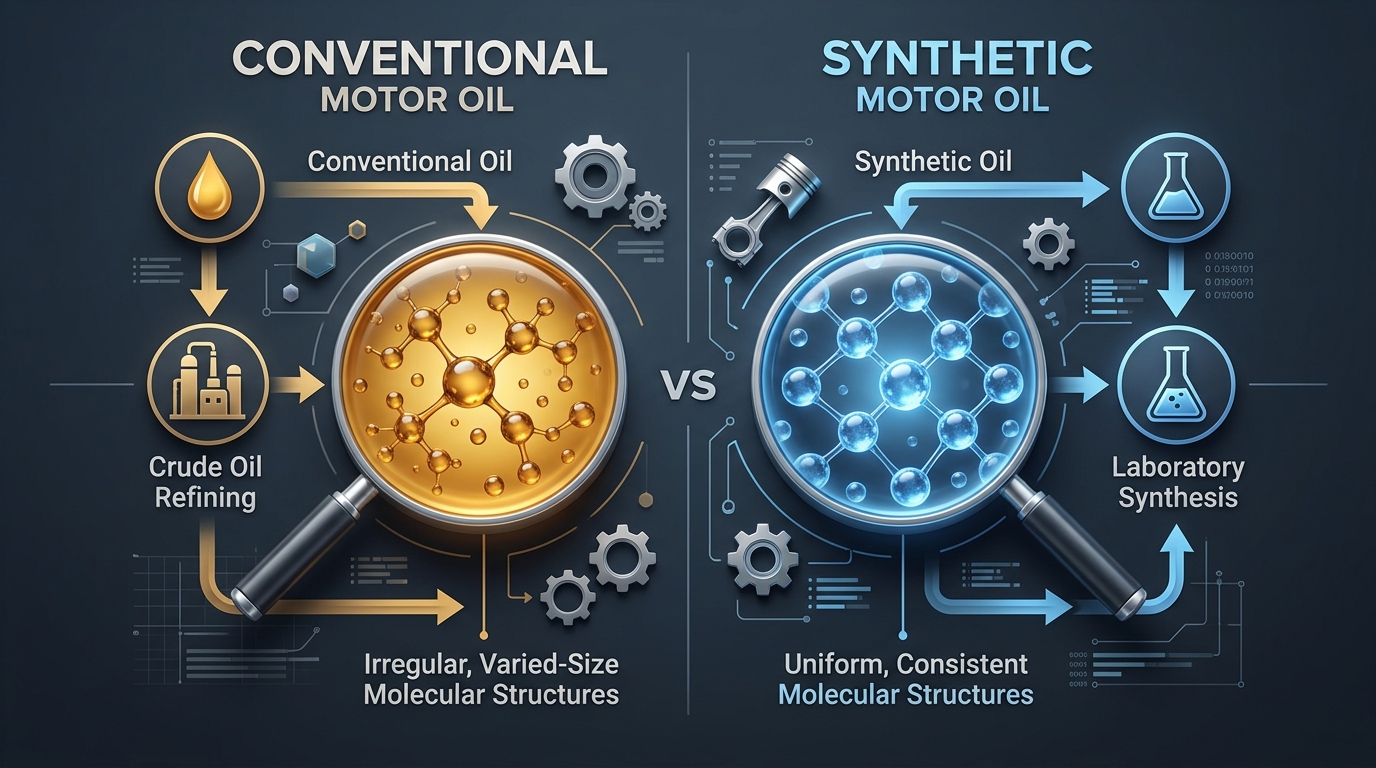
Yes, regular motor oil is refined directly from petroleum crude oil, leaving natural impurities and inconsistent molecular structures, whereas synthetic oil is chemically engineered from synthesized base stocks to achieve uniform molecular sizing and extreme chemical purity. According to the API Engine Oil Service Category Charts, conventional lubricants undergo basic distillation processes that extract usable base oils, but they retain varying molecular shapes that can break down under heat and stress. In contrast, full synthetic oil is constructed in laboratory environments through precise chemical synthesis. This controlled engineering aligns every molecule to identical lengths and structures, significantly reducing internal fluid friction, resisting sludge formation, and maintaining consistent protective film strength across demanding engine operations.
Engine lubricants are classified by SAE viscosity grades alongside API service categories and ILSAC resource-conserving designations. The current standard for gasoline engines is API SP, which is specifically formulated to guard against low-speed pre-ignition, timing-chain wear, and high-temperature turbocharger deposits. While conventional oils can be formulated with additive packages to meet basic baseline standards, their petroleum-derived base stocks naturally contain wax, sulfur, and asphaltic compounds that degrade much faster when exposed to elevated operating temperatures. Synthetic base oils eliminate these volatile compounds entirely, providing a stable foundation that allows advanced anti-wear agents, detergents, and dispersants to function at maximum efficiency.
For vehicle owners reviewing their maintenance schedule, selecting the correct oil begins with the vehicle manufacturer specifications. Modern engines feature tight internal clearances, variable valve timing actuators, and direct-injection fuel systems that demand rapid oil circulation from the moment the ignition turns over. Conventional oil flows more sluggishly during cold starts, creating brief moments where metal surfaces rub without adequate fluid separation. If you need help finding your vehicle's factory oil requirement or want to check your oil level in person, stop by our Shelbyville service center or speak directly with our team by giving our service department a call at (931) 536-4424.
Table of Contents
- Does Synthetic Oil Offer Better Viscosity Stability Under Extreme Conditions?
- Do Turbocharged Engines Require Synthetic Oil to Prevent Thermal Breakdown?
- What Happens If You Accidentally Mix Synthetic and Regular Motor Oil?
- What Is the Average Price Difference Per Oil Change and Can You Go 10,000 Miles?
- What Should You Ask a Shop to Ensure They Use the Correct Synthetic Oil?
- Common Questions About Engine Lubrication and Synthetic Oil Performance
Does Synthetic Oil Offer Better Viscosity Stability Under Extreme Conditions?
Synthetic oil provides superior viscosity stability under extreme temperatures because its uniform molecular matrix resists thinning out in severe heat and thickening in cold weather. Viscosity measures a fluid's resistance to flow, and conventional oil naturally thins as engine temperatures rise, reducing the protective oil barrier between heavy-load engine components like crankshaft bearings and camshaft lobes. Under high shear forces, petroleum-based lubricants experience molecular shearing, where long polymer chains break apart permanently, causing fluid viscosity to drop below safe operational thresholds. Synthetic lubricants maintain structural integrity across broader operating ranges, holding their rated viscosity grade even when engine temperatures spike during heavy towing, steep climbs, or prolonged idling.
Cold-weather performance represents another area where synthetic chemistry outperforms crude-refined alternatives. When ambient temperatures drop, natural paraffinic waxes present in conventional oil solidify, causing the liquid to thicken into a heavy sludge that resists pumping through narrow engine galleries. Synthetic oils contain no wax, enabling low-temperature fluidity that allows rapid oil pressure buildup during cold starts. For drivers navigating the rolling hills around Tullahoma or taking frequent highway trips near Arnold Air Force Base, maintaining instant lubrication during sudden morning temperature drops prevents microscopic scuffing on cylinder walls and valve train components.
| Lubricant Property | Conventional Motor Oil | Full Synthetic Motor Oil |
|---|---|---|
| Base Stock Source | Refined Petroleum Crude | Synthesized Chemical Compounds |
| Molecular Structure | Irregular Sizes and Shapes | Uniform Sizing and Structure |
| High-Temperature Shearing | Prone to Rapid Thinning | Resists Thermal Breakdown |
| Low-Temperature Pumping | Wax Content Causes Thickening | Wax-Free Liquid Flow |
| Oxidation Resistance | Moderate Sludge Vulnerability | High Resistance to Varnish |
Maintaining proper viscosity stability helps preserve long-term engine health, especially for high-mileage powertrains or hard-working utility vehicles. If your vehicle is due for routine fluid maintenance or requires a comprehensive multi-point inspection, you can easily schedule a routine service appointment online. For drivers considering upgrading their daily driver, exploring our quality pre-owned vehicle inventory offers access to thoroughly inspected trucks and SUVs equipped with modern, efficient powertrains designed around advanced synthetic fluid standards.
Do Turbocharged Engines Require Synthetic Oil to Prevent Thermal Breakdown?
Modern turbocharged gasoline engines almost universally require synthetic oil because turbocharger center housing bearings operate at rotational speeds exceeding 100,000 RPM and temperatures well above 400 degrees Fahrenheit. The turbocharger relies entirely on engine oil for shaft lubrication and critical thermal cooling. When a vehicle shuts down after hard operation, heat soaking occurs as residual exhaust heat radiates back into the stationary turbocharger housing. Conventional motor oil trapped inside hot turbo oil lines can bake and decompose into hardened carbon deposits, a damaging process known as oil coking. These baked carbon particles restrict oil feed lines, starving turbine bearings of lubrication and ultimately leading to premature turbocharger failure.
Synthetic oil resists thermal breakdown and coking because its high flash point and chemical stability prevent oxidation under concentrated thermal stress. Industry standards like ILSAC GF-6A were established specifically to protect direct-injected turbocharged engines against internal wear, sludge build-up, and timing chain degradation. Advanced powertrains like the Ford 2.0L EcoBoost and 3.5L EcoBoost rely on full synthetic or synthetic-blend lubricants meeting specific manufacturer approvals, such as Ford WSS-M2C specifications, to maintain peak boost pressure and long-term powertrain durability.
The severe operating environment of a turbocharger highlights the stark difference in oil degradation rates between lubricant types:
- Thermal Endurance: Synthetic base oils sustain extreme heat exposure without vaporizing or forming carbon crusts along turbo oil feed passages.
- Deposit Control: High-performance detergent additives actively neutralize acidic combustion byproducts, holding microscopic particles in suspension before they settle onto valve stems or piston rings.
- Shear Protection: Synthetic molecules resist mechanical tearing under intense mechanical pressure within turbine shaft journals.
Protecting a modern boosted engine requires consistent adherence to manufacturer fluid specifications and timely maintenance intervals. Drivers interested in low-mileage, manufacturer-backed vehicles equipped with advanced EcoBoost powertrains can browse our certified pre-owned inventory to find models that have undergone stringent multi-point inspections and complete fluid verifications.
What Happens If You Accidentally Mix Synthetic and Regular Motor Oil?
Accidentally mixing synthetic and regular motor oil will not cause engine damage, chemical gelation, or mechanical failure because both lubricant types are derived from compatible hydrocarbon base stocks. Modern motor oils are specifically engineered to be fully miscible with one another. If you need to top off a low oil level during a road trip and only conventional oil is available, adding a quart to an engine filled with synthetic oil is entirely safe and far better for engine health than running low on oil volume.
However, blending conventional petroleum oil into a reservoir of full synthetic oil instantly dilutes the performance benefits of the synthetic lubricant. The overall blend takes on the characteristics of the lower-grade fluid, lowering heat resistance, reducing oxidation stability, and shortening the oil's effective lifespan. When local drivers ask our service advisors about emergency top-offs, they often wonder if mixing leftover synthetic oil with conventional oil during a trip will cause clumping or immediate engine damage. The short answer is no, but your engine will no longer benefit from extended drain protection until a full oil and filter change is performed.
Full Synthetic Base + Conventional Top-Off = Diluted Hybrid Blend
  ├── Lubrication Integrity: Preserved (No Mechanical Damage)
  ├── Heat & Shear Resistance: Reduced to Lowest-Grade Oil Level
  └── Recommended Action: Resume Standard Drain Interval (~5,000 miles)
If an accidental oil mix occurs, adjust your maintenance window back to a conservative conventional interval of roughly 5,000 miles rather than pushing out to an extended synthetic range. Keeping track of maintenance history is essential when evaluating overall vehicle value over time. If you are planning an upgrade or want to apply your current vehicle's value toward a newer model, you can quickly value your trade-in online to get an accurate estimate based on current market conditions.
What Is the Average Price Difference Per Oil Change and Can You Go 10,000 Miles?
A full synthetic oil change generally carries an upfront cost premium over a conventional oil service, but synthetic oil can safely support service intervals up to 10,000 miles when authorized by the vehicle manufacturer and monitored by an onboard oil-life tracking system. Conventional motor oil typically requires replacement every 3,000 miles to 5,000 miles due to rapid chemical breakdown and additive depletion. Because synthetic oil resists oxidation and maintains viscosity far longer, owners can often double the mileage between service visits. Over a typical year of driving, paying slightly more per service for two synthetic oil changes often costs less in total maintenance spend and takes less time than paying for three or four conventional oil changes.
Commuters traveling daily along the busy corridors near Spring Hill often experience heavy stop-and-go idling that accelerates lubricant degradation. In these severe driving conditions, relying on a baseline mileage figure alone can be misleading. Onboard Intelligent Oil-Life Monitor systems continuously calculate engine revolutions, operating temperatures, ambient weather, and trip duration to determine true oil degradation rather than relying solely on odometer distance.
Factors that dictate whether an engine can safely stretch to a 10,000 miles interval include:
- Driving Environment: Frequent short trips under five miles, stop-and-go commuting, and extreme summer temperatures degrade oil faster, requiring shorter service intervals.
- Towing and Cargo Load: Hauling heavy trailers or carrying continuous payload increases internal engine temperatures, demanding earlier fluid changes regardless of oil type.
- Filter Quality: An extended-interval synthetic oil change must always be paired with an OEM-grade filter designed to capture microscopic contaminants over extended mileage without clogging or bypassing.
Balancing routine maintenance investments with long-term vehicle ownership costs keeps your vehicle running efficiently for years. For shoppers looking to purchase a new or pre-owned vehicle while managing monthly vehicle expenses, our finance specialists simplify the process by allowing you to begin applying for vehicle financing online from the comfort of home.
What Should You Ask a Shop to Ensure They Use the Correct Synthetic Oil?
To verify that a service facility installs the exact lubricant required for your engine, ask the service advisor to confirm the oil's viscosity grade, verify that the fluid meets the specific API service category or OEM specification number listed in your owner's manual, and check that an OEM-equivalent oil filter is installed. Many modern gasoline engines require ultra-low viscosity grades like 0W-20 or 5W-20 formulated to support tight engine bearing clearances and optimize fuel efficiency. Installing a generic, heavy-weight oil can impede rapid lubrication during startup, trigger oil pressure warning lights, and negatively affect variable valve timing operation.
Always confirm that the service ticket explicitly lists the brand, oil specification, and exact part number of the fluid poured into your crankcase. For Ford owners, confirming that the fluid carries approved Ford WSS-M2C certification ensures full compliance with factory powertrain warranty standards. Inquiring about the filter grade is equally critical, as low-quality aftermarket filters may lack proper anti-drainback valves, allowing oil to drain out of top-end oil passages when the engine is parked overnight.
Key questions to ask your service provider before approving maintenance work include:
- "Does this synthetic oil meet the exact API SP or manufacturer specification code required by my vehicle's manual?"
- "What viscosity grade are you putting in, and does it match the factory oil cap requirement?"
- "Is the oil filter being installed rated for extended synthetic drain intervals?"
- "Will this oil service maintain my original manufacturer powertrain warranty coverage?"
When you want complete confidence in your vehicle's maintenance, using genuine fluids and factory-approved components is essential. Shoppers exploring our selection of new Ford vehicles receive factory-recommended maintenance support right from day one. If you prefer performing your own fluid changes at home, our dedicated team can assist you with ordering OEM parts and fluids directly through our dealership.
Common Questions About Engine Lubrication and Synthetic Oil Performance
Q: What is the main technical difference between synthetic and regular motor oil?
A: The primary technical difference lies in molecular structure and purity. Regular motor oil is refined directly from crude oil and contains irregular molecules alongside natural impurities like sulfur and wax. Synthetic oil is chemically engineered from uniform base stocks, delivering consistent molecular size, superior resistance to extreme heat, improved low-temperature cold-start flow, and stronger protection against engine sludge buildup.
Q: Can switching to full synthetic oil cause oil leaks in older vehicles?
A: Switching to full synthetic oil does not cause engine seals or gaskets to leak. This myth originated decades ago when early synthetic formulations contained chemical compounds that reacted with older neoprene seals. Modern synthetic oils are formulated to be fully compatible with all contemporary gasket materials. However, because synthetic oil cleans away baked-on engine deposits, it may expose pre-existing mechanical gaps or worn seals that were previously plugged by sludge.
Q: Does using synthetic oil help improve cold-weather engine starts?
A: Yes, synthetic oil significantly improves engine cranking performance during cold weather. Because synthetic lubricants contain no natural paraffin waxes that thicken in freezing temperatures, the fluid remains thin and pliable. This allows the engine starter motor to turn the crankshaft with less resistance while pumping protective oil to upper valve train components within seconds of ignition.
Q: How does the Ford Intelligent Oil-Life Monitor determine when an oil change is needed?
A: The Intelligent Oil-Life Monitor uses advanced algorithms to track actual engine operating conditions rather than relying solely on miles driven. It continuously analyzes engine operating temperatures, ambient air temperatures, short-trip frequency, towing loads, and total engine revolutions. When driving conditions are severe, the system alerts the driver to service the engine earlier than standard highway intervals.
Q: Will using a non-approved synthetic oil void a vehicle's factory warranty?
A: Under federal law, using an aftermarket or non-OEM oil brand will not automatically void your warranty, provided the fluid meets or exceeds the viscosity grade and engine specification codes required by the manufacturer. However, using an unapproved oil that fails to meet required standards—such as running an uncertified oil in a turbocharged engine that suffers oil coking—can lead to denied warranty claims for resulting component failure.
Taking proactive care of your vehicle's engine lubrication is the single best way to ensure maximum reliability, optimum fuel economy, and long-term performance. Whether your vehicle needs a routine synthetic oil service, a comprehensive mechanical checkup, or factory-approved replacement parts, our dedicated service team at Newton Ford South is here to help. Explore our interactive map for directions, reach out directly by calling (931) 536-4424, or take a moment to learn more about our dealership team before scheduling your next maintenance visit.
© 2026 Newton Ford South. All rights reserved.