How Do You Calculate the Real Loaded Weight of a Horse Trailer?
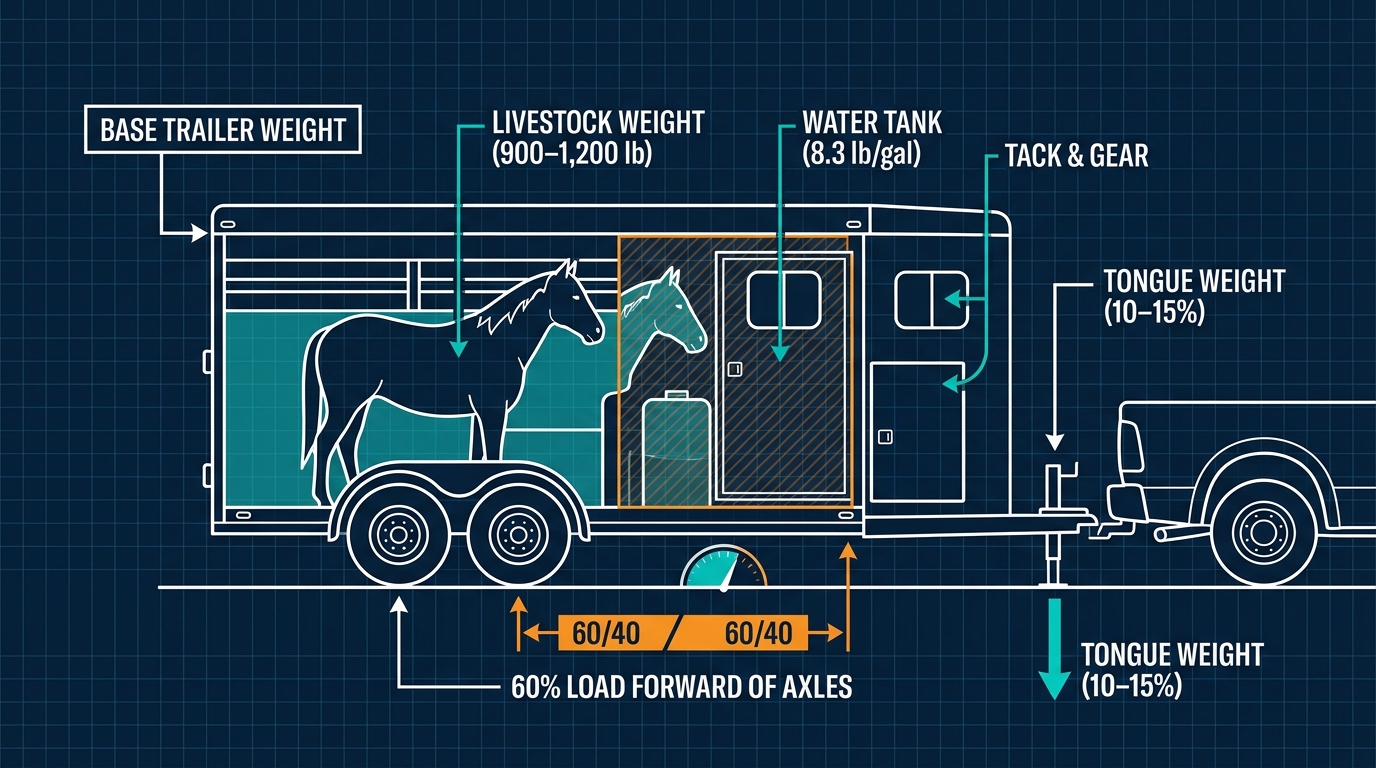
Calculating the real loaded weight of a horse trailer requires adding the manufacturer empty trailer weight to the combined weight of all horses, filled water tanks, tack, hay bales, and onboard gear. An adult Tennessee Walking Horse weighs between 900 and 1,200 lb, while an empty 2-horse bumper pull trailer ranges from 2,400 to 3,500 lb. Adding two horses, 50 gallons of water, and show equipment regularly brings total trailer weight to 6,500 lb or more.
| HORSE TRAILER LOADED WEIGHT CALCULATION |
| --- |
| Base Trailer Weight (Empty Steel/Aluminum Frame) |
| + Total Weight of Livestock (900–1,200 lb per horse) |
| + Onboard Water (approx. 8.3 lb per gallon) |
| + Tack, Saddles, & Show Apparel |
| + Hay Bales & Feed Bags |
| + Portable Fencing, Generators, & Miscellaneous Gear |
| = TOTAL GROSS TRAILER WEIGHT (GTW) |
Knowing your exact numbers prevents exceeding your truck's certified payload rating and axle weight limits. Equipment weights accumulate faster than most owners anticipate. For instance, a full 50-gallon water tank adds over 400 lb, while four bales of hay and a full tack room add another 300 to 500 lb.
Weight placement inside the trailer matters just as much as total mass. Safe trailering guidelines require placing approximately 60 percent of the total load forward of the trailer axles. Proper placement maintains adequate tongue weight—typically 10 to 15 percent of gross trailer weight for bumper pull couplers and 20 to 25 percent for gooseneck hitches. Insufficient tongue weight causes dangerous trailer sway at highway speeds, while excessive tongue weight overloads the tow vehicle rear suspension and lightens steering traction on the front axle.
Before hitting the highway for an equine event, double-check your hitch rating, safety chain working load limits, and tire inflation pressures. If you want our team to inspect your vehicle's factory receiver hitch or verify your tow package rating, stop by our dealership located at 2811 US-231 in Shelbyville or give our service desk a quick call to speak with a specialist.
Table of Contents
- Should You Buy a Truck Based on Max Tow Rating or Real Trailer Weight?
- Why Are Towing Logistics Around the Tennessee Walking Horse Celebration So Busy?
- Should You Weigh Your Trailer and How Often Do Wheel Bearings Need Maintenance?
- Common Horse Trailer Towing Questions Before Heading to the Celebration
- Preparing Your Truck and Rig for Safe Trailering
Should You Buy a Truck Based on Max Tow Rating or Real Trailer Weight?
Selecting a tow vehicle based on actual loaded trailer weight plus a safety buffer of 15 to 20 percent provides reliable hill-climbing power, stable braking, and long-term drivetrain protection. Relying solely on a truck's advertised maximum tow rating often leaves drivers under-equipped because max ratings assume an empty cab, a lightweight driver, and flat highway terrain. A fully loaded 2-horse bumper pull trailer carrying two horses and show equipment usually weighs between 5,000 and 7,500 lb, meaning a tow vehicle rated for an 8,500-lb towing capacity or higher is necessary for stress-free hauling.
When matching a truck to an equine load, payload capacity frequently becomes the limiting factor before towing capacity is reached. Payload accounts for everything added to the truck, including cab passengers, cargo in the bed, and trailer tongue weight. A heavy gooseneck trailer placing 2,000 lb of tongue weight directly onto the truck bed requires a heavy-duty pickup with a high Gross Axle Weight Rating (GAWR) and substantial payload headroom.
| Vehicle Setup | Empty Trailer Mass | Typical Livestock & Gear | Minimum Recommended Tow Rating | Key Weight Factor |
|---|---|---|---|---|
| 2-Horse Bumper Pull | 2,400 to 3,500 lb | 2,200 to 3,500 lb | 8,500-lb towing capacity | Tongue Weight (10–15%) |
| 2-Horse Gooseneck | 4,000 to 5,500 lb | 2,500 to 4,000 lb | 12,000-lb towing capacity | Bed Payload (20–25%) |
| 4-Horse Gooseneck w/ Living Quarters | 7,500 to 10,000 lb | 4,500 to 7,000 lb | 18,000-lb towing capacity | Rear Axle Rating (GAWR) |
When buyers walk our showroom floor comparing trucks for horse hauling, they usually ask whether to base their decision on maximum tow ratings or real-world loaded trailer weight before looking at trim features. Upgrading to a vehicle equipped with integrated trailer brake controls, heavy-duty engine cooling, and specialized tow modes transforms the trailering experience. You can explore our current new Ford inventory to see pickups configured with factory trailer packages, or check our pre-owned vehicle selection for capable haulers. If you are planning your purchase budget, our specialists can walk you through prequalifying for vehicle financing online.
Why Are Towing Logistics Around the Tennessee Walking Horse Celebration So Busy?
Towing logistics become exceptionally busy during the event because over 2,000 competition horses and 100,000 attendees enter a single venue facility within a multi-day period. The historic 100-plus-acre venue complex in Shelbyville houses 45 barns with more than 850 stalls and 300 RV hookups, creating high-density traffic on surrounding access roads and tight maneuvering within showground parking areas.
<strong>TENNESSEE LEGAL TRAILER REQUIREMENTS SUMMARY</strong>

| Trailer Weight Band | Mandatory Brake Equipment |
| --- | --- |
| 1,500 to 2,999 lb | Brakes required on at least one axle |
| 3,000 lb and above | Brakes required on ALL wheels |
| Mandatory Hardware | Integrated brake controller for GVWR > 1,500 lb |
| Safety Chains | Dual chains crossed under tongue; WLL > GVWR |
| Tire Inspection | Minimum 2/32 in. tread depth; zero sidewall rot |
Navigating crowded showgrounds with long rigs demands accurate backing technique and the right equipment setup. Gooseneck trailers pivot directly over the truck rear axle, allowing sharper turning angles and tighter maneuvering around barn aisles than bumper pull setups. However, bumper pull trailers remain popular for smaller two-horse setups due to lower overall combination length and compatibility with full-size SUVs and light-duty pickups.
State trailering regulations add another operational requirement for travelers heading to the grounds:
- Tennessee law mandates functioning brakes on all wheels for any trailer with a gross vehicle weight of 3,000 lb or more, and brakes on at least one axle for trailers between 1,500 and 3,000 lb.
- A functioning trailer brake controller is legally required whenever trailer Gross Vehicle Weight Rating (GVWR) exceeds 1,500 lb.
- Safety chains must be installed in pairs, crossed beneath the trailer tongue, secured directly to the tow vehicle frame, and rated with a working load limit exceeding the trailer's total GVWR.
- Tires must maintain at least 2/32 inch tread depth in major grooves, with zero sidewall bulges or severe dry rot.
Ensuring your tow vehicle meets these mechanical and legal standards keeps your horses safe and protects other drivers during heavy event traffic. You can learn more about how our team supports local horse owners by reviewing why drivers choose Newton Ford South, or browse our certified pre-owned inventory for thoroughly inspected trucks equipped with factory hitch receivers and wiring harnesses.
Should You Weigh Your Trailer and How Often Do Wheel Bearings Need Maintenance?
Weighing your fully loaded horse trailer at a commercial scale before long trips confirms actual operating weight, while wheel bearings must be inspected and repacked with grease every 12 months or 12,000 miles to prevent hub failure. Weighing your rig loaded with horses, water, and tack provides exact scale figures for steer axle load, drive axle load, and total trailer axle weight, eliminating reliance on estimates.
| ANNUAL TRAILER MAINTENANCE CHECKLIST |
| --- |
| [ ] Repack wheel bearings with high-temp grease |
| [ ] Inspect grease seals and replace worn double-lip |
| [ ] Check brake shoe lining thickness & magnet wear |
| [ ] Test emergency breakaway switch & 12V battery |
| [ ] Inspect tire sidewalls & torque lug nuts |
Proper wheel bearing maintenance protects your axles from heat buildup caused by heavy loads and highway speeds. Over time, grease breaks down, breaks seal barriers, or becomes contaminated by road dust and moisture. During service, technicians remove hub assemblies, clean bearings, inspect spindles for scoring, replace inner grease seals, and pack high-temperature grease into the roller assemblies.
A thorough pre-trip check also covers vital safety systems:
- Test the electric brake controller at low speed to ensure smooth brake application without locking the trailer wheels.
- Check the emergency breakaway system battery voltage and pull the lanyard to verify full emergency brake activation.
- Walk around the vehicle to confirm operation of tail lights, brake lights, turn signals, and hazard indicators.
- Inspect tire sidewalls for dry rot cracking, verify cold inflation pressures match trailer manufacturer specifications, and check wheel lug torque.
Proper pre-trip maintenance protects your investment and ensures comfortable travel for your horses across local farmland routes. Near Tullahoma, service personnel regularly assist military families and agricultural haulers who require heavy-duty tow checks before long road trips. If your truck or trailer needs a safety check, easily book a service appointment online to have certified technicians inspect your vehicle's towing hardware, or evaluate your current truck's trade value when planning an upgrade.
Common Horse Trailer Towing Questions Before Heading to the Celebration
Q: What towing capacity is required for a 2-horse bumper pull trailer carrying Tennessee Walking Horses?
A 2-horse bumper pull trailer loaded with two Tennessee Walking Horses, full water tanks, saddles, and feed typically weighs between 5,000 and 7,500 lb. To haul this weight safely over rolling terrain, your truck should feature a minimum manufacturer rating of 8,500-lb towing capacity to 10,000-lb towing capacity. This extra capacity provides critical safety headroom for braking stability, transmission cooling, and climbing highway grades without overworking the engine.
Q: How does gooseneck hitching affect payload capacity compared to bumper pull setups?
Gooseneck hitches place trailer tongue weight directly over the tow vehicle's rear axle rather than behind the rear bumper. This configuration transfers roughly 20 to 25 percent of the total trailer weight onto the truck bed, significantly increasing the demand on your vehicle's payload capacity and rear GAWR. While gooseneck trailers offer superior stability and tighter turning capabilities, they require a truck with a high payload rating—typically a three-quarter-ton or one-ton pickup—to carry the heavy vertical pin weight.
Q: What is the legal requirement for trailer breakaway systems in Tennessee?
Tennessee state regulations require trailers equipped with power brakes to feature an operational emergency breakaway system powered by an onboard 12-volt battery. The breakaway cable attaches to the tow vehicle frame, and if the trailer uncouples while moving, the switch pulls free to engage the electric trailer brakes automatically. The onboard breakaway battery must be fully charged and tested prior to every trip to ensure sufficient electric current to lock the trailer brakes during an emergency separation.
Q: How do you adjust an electric trailer brake controller before hauling heavy livestock?
To calibrate an electric brake controller, drive the loaded rig on a flat paved surface at approximately 20 mph and manually activate the controller slider lever without pressing the truck brake pedal. Adjust the gain setting upward until the trailer brakes begin to lock, then back the gain down slightly until the trailer decelerates smoothly without skidding. Proper brake gain adjustment ensures the trailer assists with stopping power without tugging violently on the tow vehicle or causing wheel lockup.
Q: What brake and suspension components should be inspected before towing long distances?
Before towing long distances, inspect truck brake pads, rotors, trailer brake shoes, brake drums, and electric magnet surfaces for uneven wear. On the suspension side, inspect truck rear leaf springs, shocks, trailer leaf spring bushings, equalizer bars, and U-bolts for cracks or sagging. Verifying that trailer wiring harnesses are free of corrosion and ordering fresh replacement towing hardware through our parts department keeps your towing electrical system reliable throughout the show season.
Preparing Your Truck and Rig for Safe Trailering
Preparing your truck and horse trailer for travel requires verifying trailer weights, inspecting safety hardware, and ensuring your tow vehicle has the mechanical capacity to handle the load. Taking time to calculate total GTW, check tire pressures, repack wheel bearings, and test brake controllers ensures stress-free travel for both driver and horses.
| FINAL PRE-HAUL SAFETY CHECKLIST |
| --- |
| 1. Verified GTW and tongue weight on commercial axle scales |
| 2. Confirmed truck payload and rear GAWR are within limits |
| 3. Checked safety chain WLL and crossed placement under tongue |
| 4. Tested electric brake controller gain and 12V breakaway system |
| 5. Checked tire inflation, tread depth, and wheel lug torque |
Our service technicians assist horse owners by installing fifth-wheel and gooseneck hitch packages, mounting factory brake controllers, and performing complete tow-vehicle inspections. Bringing your vehicle in for professional service before peak show season prevents roadside breakdowns and protects your valuable equine cargo.
When you are ready to prepare your truck for the upcoming show season, stop by our showroom for a consultation at 2811 US-231 in Shelbyville or reach out to our team with a quick call to speak directly with our service and sales specialists.
© 2026 Newton Ford South. All rights reserved.