What Is the Expected 5-Year Depreciation Rate for a Honda CR-V?
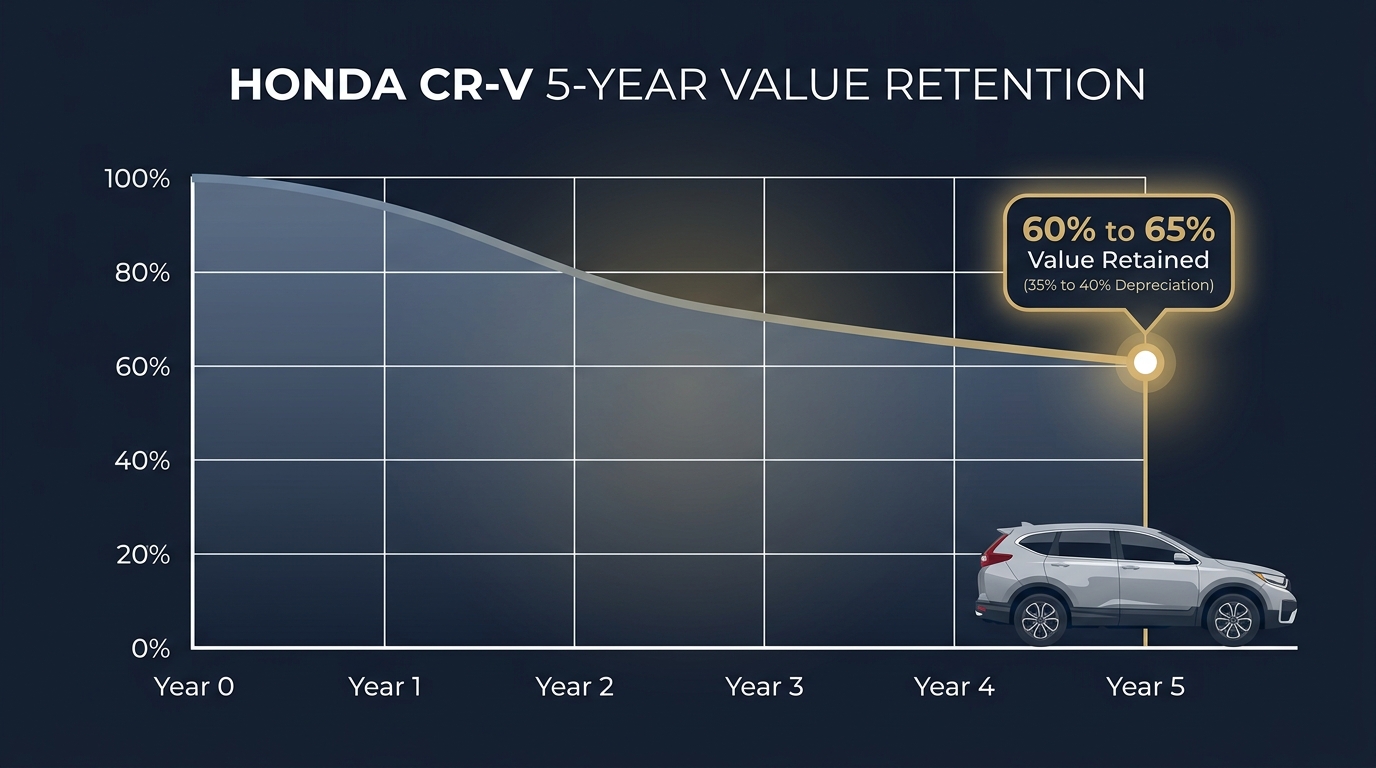
A Honda CR-V typically experiences an expected 5-year depreciation rate between 35% and 40%, meaning it retains roughly 60% to 65% of its original purchase price after five years of ownership. This places the CR-V among the top performers for value retention in the compact crossover segment, giving buyers a solid baseline for overall trade-in value.
Understanding depreciation rates helps shoppers evaluate the true total cost of ownership over a typical five-year finance cycle. While low initial depreciation reduces value loss during early ownership, the final residual value depends heavily on annual mileage, routine vehicle maintenance, overall exterior condition, and vehicle trim level. When drivers compare the long-term financial picture of a Honda CR-V against competing crossover SUVs, the starting purchase price and available manufacturer incentives play an equally decisive role in calculating net ownership costs.
Ford SUVs, such as the Ford Escape and Ford Bronco Sport, counter strong competitive residual scores by offering accessible starting price points, comprehensive standard technology packages, and robust regional trade-in demand. For shoppers evaluating long-term value in Middle Tennessee, factor in both residual percentage expectations and initial outlay. Our financial specialists at Newton Ford South frequently walk buyers through trade-in projection calculations to help compare expected residual values against actual purchase pricing. To discuss your equity goals or explore vehicle inventory in person, stop by our Shelbyville showroom location or give our sales desk a quick call at (931) 536-4424.
Table of Contents
- How Does Honda CR-V Cargo Space and Passenger Volume Compare to the Ford Escape?
- What Are the Engine Options and Horsepower Differences Between the Honda CR-V and Ford Bronco Sport?
- Which SUV Delivers Superior Off-Road Capability and Towing Capacity: CR-V or Bronco Sport?
- How Do Long-Term Value, Financing, and Ownership Costs Compare for Ford and Honda SUVs?
- Frequently Asked Questions About the Honda CR-V vs Ford SUV Lineup
- Find Your Ideal Family SUV Today
How Does Honda CR-V Cargo Space and Passenger Volume Compare to the Ford Escape?
The 2026 Honda CR-V provides up to about 39 cubic feet of rear cargo space behind the second row and about 106 cubic feet of total passenger volume, while the Ford Escape offers up to about 37.5 cubic feet of rear cargo room, about 102 cubic feet of passenger volume, and standard 60/40 split-folding sliding second-row seats that slide forward up to 5.9 inches to expand cargo capacity without lowering the back seats.
While raw dimensional specifications favor the Honda CR-V by a narrow margin, the Ford Escape delivers superior practical cargo flexibility through its sliding second-row mechanics. Sliding the rear seats forward allows drivers to accommodate larger items, bulky sporting gear, or extra luggage while keeping five passengers comfortably seated. When rear seats are completely folded, the Honda CR-V expands to about 76.5 cubic feet of total cargo volume compared to about 65 cubic feet in the Ford Escape.
Cabin entry, liftover height, and everyday interior usability also distinguish these two compact crossovers. The Honda CR-V features a wide rear tailgate opening with a low liftover height, facilitating straightforward loading for heavier cargo. Conversely, the Ford Escape emphasizes passenger ergonomic comfort with versatile seat adjustment configurations and intelligent storage cubbies located throughout the cabin.
Suburban families commuting daily through Spring Hill often discover that the sliding rear seat capability in the Ford Escape makes loading strollers, grocery bags, and school backpacks far easier during busy morning drop-offs. To review detailed interior cabin comparisons and model breakdowns, explore our dealership automotive blog, read more about why area drivers choose our dealership, or browse our new Ford Escape inventory to find the ideal setup for your household needs.
Dimensions & Capacity
Capacity and dimensions by trim
| Feature | Badlands 4X4 | Big Bend 4X4 | Heritage 4X4 | Outer Banks 4X4 |
|---|---|---|---|---|
| :-- | :-- | :-- | :-- | :-- |
| Seating | 5 | 5 | 5 | 5 |
| Cargo | 29.4 cu ft | 32.5 cu ft | 32.5 cu ft | 32.5 cu ft |
| Curb weight | 3,809 lbs | 3,458 lbs | 3,458 lbs | 3,458 lbs |
| Towing | 2,700 lbs | 2,200 lbs | 2,200 lbs | 2,200 lbs |
| Payload | 3,081 lbs | 2,847 lbs | 2,847 lbs | 2,847 lbs |
What Are the Engine Options and Horsepower Differences Between the Honda CR-V and Ford Bronco Sport?
The 2026 Honda CR-V offers two powertrain choices—a 1.5-liter turbocharged 4-cylinder making 190 horsepower or an available 2.0-liter hybrid system producing 204 horsepower—while the 2026 Ford Bronco Sport provides a standard 1.5L engine generating 180 hp and 200 lb-ft of torque, alongside a high-output 2L engine producing 238 hp and 277 lb-ft of torque paired with an eight-speed automatic featuring SelectShift®.
Engine output directly dictates how each compact SUV accelerates on highway entrance ramps and handles passing maneuvers under full load. The Honda CR-V relies on continuous variable transmissions across its gas lineup to maximize steady fuel economy, whereas the Honda CR-V Hybrid uses dual electric motors to deliver immediate low-speed response. The Ford Bronco Sport utilizes traditional multi-speed automatic transmissions and turbocharged torque delivery to provide responsive throttle feedback both on paved highways and unpaved secondary backroads.
For drivers seeking maximum engine performance, the Ford Bronco Sport Badlands 4X4 trim equipped with the 2L turbocharged engine delivers 238 hp and 277 lb-ft of torque, significantly outpowering both the standard gas and hybrid powertrains of the Honda CR-V. Meanwhile, the Ford Bronco Sport Big Bend 4X4, Heritage 4X4, and Outer Banks 4X4 trims come equipped with the efficient 1.5L engine producing 180 hp and 200 lb-ft of torque backed by standard All-wheel drive.
If your driving routines prioritize muscular torque and lively highway responsiveness, compare these powertrain builds in person. Take a look at our current Ford Bronco Sport lineup, check out our selection of full-size Ford Bronco models, or examine budget-friendly options in our pre-owned vehicle inventory.
Engine & Performance
Powertrain specs by trim
| Feature | Badlands 4X4 | Big Bend 4X4 | Heritage 4X4 | Outer Banks 4X4 |
|---|---|---|---|---|
| :-- | :-- | :-- | :-- | :-- |
| Engine | 2L | 1.5L | 1.5L | 1.5L |
| Horsepower | 238 hp | 180 hp | 180 hp | 180 hp |
| Torque | 277 lb-ft | 200 lb-ft | 200 lb-ft | 200 lb-ft |
| Drivetrain | All-wheel drive | All-wheel drive | All-wheel drive | All-wheel drive |
Which SUV Delivers Superior Off-Road Capability and Towing Capacity: CR-V or Bronco Sport?
The Ford Bronco Sport delivers clear superiority in off-road capability and maximum towing performance, offering a towing capacity up to 2,700 lbs when equipped with the 2L engine and standard All-wheel drive, compared to the Honda CR-V which maxes out at 1,500 pounds of towing capacity on gas models and 1,000 pounds on hybrid trims.
Off-road engineering separates these two vehicles significantly. The Honda CR-V utilizes a light-duty, pavement-focused Real Time All-wheel drive system on lower trims, reserving standard all-wheel drive primarily for its TrailSport and Sport Touring Hybrid models. Ground clearance on the Honda CR-V remains suited mainly for light snow and well-maintained unpaved dirt roads.
In contrast, every Ford Bronco Sport comes standard with intelligent All-wheel drive, high ground clearance, short front and rear overhangs, and terrain management drive modes engineered to tackle loose gravel, mud, rutted trails, and steep inclines. The range-topping Badlands 4X4 model adds an advanced twin-clutch rear drive unit with a differential lock, metal bash plates, and specialized off-road suspension calibration.
For weekend utility across rural farm acreage and gravel lanes in Bedford County, the extra 1,200 pounds of towing capability and rugged underbody protection give the Ford Bronco Sport a distinct practical edge over the Honda CR-V when hauling utility trailers, small boats, or outdoor recreation gear. If you plan to customize your crossover with genuine towing packages or trail accessories, consult with our Ford parts center, inspect versatile options in our new Ford Maverick inventory, or check out work-ready capability in our new Ford F-150 lineup.
How Do Long-Term Value, Financing, and Ownership Costs Compare for Ford and Honda SUVs?
Long-term ownership value between Ford and Honda SUVs reflects a balance between high residual percentages and affordable upfront purchase prices, with the Honda CR-V retaining higher resale percentages over five years while Ford crossovers offer lower entry MSRP points, accessible financing structures, and highly competitive maintenance schedules.
Initial acquisition pricing plays a significant role in total five-year financial outcomes. For example, the 2026 Ford Bronco Sport features a competitive pricing structure across its model range:
- Big Bend 4X4: Base MSRP of $31,845 (plus $1,995 destination charge)
- Heritage 4X4: Base MSRP of $34,145 (plus $1,995 destination charge)
- Outer Banks 4X4: Base MSRP of $36,945 (plus $1,995 destination charge)
- Badlands 4X4: Base MSRP of $40,265 (plus $1,995 destination charge)
Lower starting purchase prices mean buyers finance smaller principal loan balances, which directly reduces monthly finance charges and total interest expenses paid over a standard 60-month or 72-month auto loan. Additionally, Ford factory warranty protection covers new vehicles with a 3-year/36,000-mile bumper-to-bumper warranty and a 5-year/60,000-mile powertrain warranty, providing dependable peace of mind.
To review payment terms that fit your household budget, complete an online vehicle credit application, get a competitive quote using our instant trade-in appraisal tool, or set up routine maintenance through our online service appointment tool.
Pricing
Pricing by trim
| Feature | Badlands 4X4 | Big Bend 4X4 | Heritage 4X4 | Outer Banks 4X4 |
|---|---|---|---|---|
| :-- | :-- | :-- | :-- | :-- |
| Base MSRP | $40,265 | $31,845 | $34,145 | $36,945 |
| Destination charge | $1,995 | $1,995 | $1,995 | $1,995 |
Frequently Asked Questions About the Honda CR-V vs Ford SUV Lineup
Q: Does the Honda CR-V or Ford Escape offer better fuel economy for daily commuting?
The Honda CR-V Hybrid achieves up to 40 mpg combined in independent testing, giving it a slight advantage over standard gas crossovers. However, the Ford Escape counters with multiple fuel-efficient engine options, including standard EcoBoost configurations and available hybrid setups that achieve highly competitive fuel economy ratings during mixed city and highway driving.
Q: Can the Ford Bronco Sport handle rougher terrain than a standard Honda CR-V?
Yes, the Ford Bronco Sport features standard All-wheel drive, higher ground clearance, and terrain management drive modes engineered specifically for off-road trails and unpaved surfaces. The Honda CR-V uses a light-duty all-wheel-drive system tailored primarily for rain, light snow, and smooth highway commuting.
Q: What driver-assistance safety features come standard on Ford compact crossovers compared to Honda Sensing?
Every Ford compact SUV includes Ford Co-Pilot360 technology as standard equipment, featuring Pre-Collision Assist with Automatic Emergency Braking, BLIS (Blind Spot Information System) with Cross-Traffic Alert, and Lane-Keeping System. This package directly compares with standard Honda Sensing driver-assist features like forward collision warning and adaptive cruise control.
Q: How does the sliding second row in the Ford Escape help with rear cargo management?
The Ford Escape features 60/40 split-fold sliding rear seats that slide forward up to 5.9 inches. This mechanical feature allows drivers to instantly expand rear trunk space for bulky luggage or groceries without folding down the back seats or displacing rear seat passengers.
Q: What is the maximum towing capacity difference between a Honda CR-V and a Ford Bronco Sport?
The Honda CR-V has a maximum towing capacity of 1,500 pounds for gas models and 1,000 pounds for hybrid variants. The Ford Bronco Sport offers up to 2,700 lbs of maximum towing capacity when equipped with the 2L engine, providing significantly greater utility for small trailers and recreational toys.
To review current dealership availability or learn more about vehicle financing, browse our complete new Ford inventory, read about our dealership values on our about us page, or check out our new Ford Mustang inventory.
Find Your Ideal Family SUV Today
With over 1.5 million units sold in the U.S. last year, compact SUVs like the Honda CR-V and Ford models dominate family vehicle choices, making it essential to match features with your lifestyle needs. While the Honda CR-V remains a popular choice for buyers prioritizing baseline residual percentages, Ford SUVs like the Ford Escape and Ford Bronco Sport deliver superior off-road capability, higher towing thresholds, flexible seating configurations, and lower initial purchase prices.
Our team at Newton Ford South is dedicated to providing straightforward information, clear pricing, and reliable service support throughout your shopping journey. Whether you require a versatile commuter crossover for daily highway travel or a rugged four-wheel-drive SUV built for outdoor weekend excursions, we are here to help you evaluate your trade-in and select the right vehicle configuration.
Take the next step in finding your ideal crossover today. Explore our Ford Super Duty inventory if you require heavy-duty capability, visit our dealership in Shelbyville for a personal test drive, or contact our sales team at (931) 536-4424 to discuss trade-in values and custom vehicle orders.
© 2026 Newton Ford South. All rights reserved.