What Is the Recommended Ford Maintenance Schedule for My Vehicle?
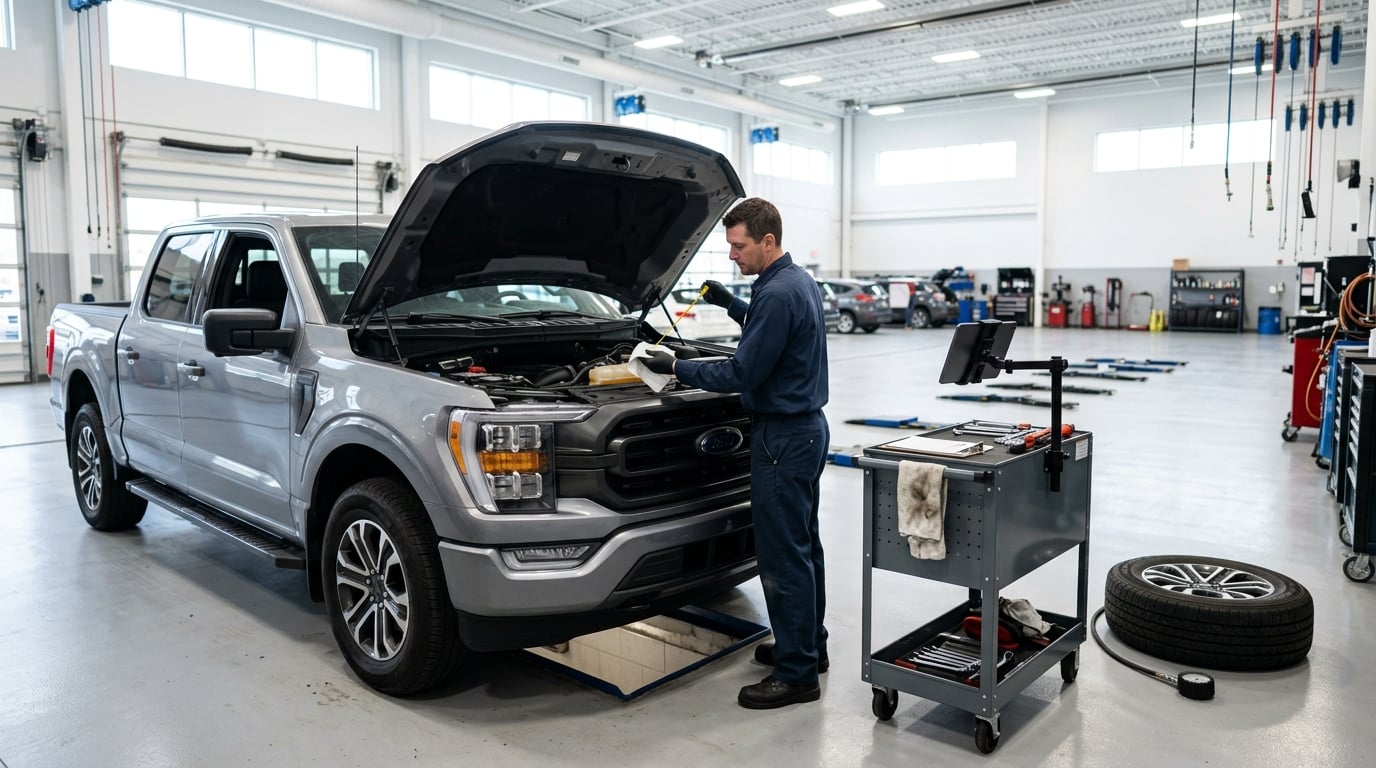
The recommended Ford maintenance schedule follows primary service intervals every 7,500 to 10,000 miles or 12 months, anchored by the Intelligent Oil-Life Monitor. At each interval, key maintenance includes an engine oil and filter change, tire rotation, and a comprehensive multi-point inspection. Major milestone services follow at 20,000 miles for cabin air filters, 30,000 miles for engine air filters, 3 years for brake fluid, and 100,000 miles for spark plug replacements.
Modern Ford engineering relies on automated onboard systems rather than fixed, rigid mileages to determine when engine oil needs replacing. The Intelligent Oil-Life Monitor continuously tracks operational data—including engine operating temperatures, idle duration, engine load, and ambient weather conditions—to calculate remaining fluid life. When oil breakdown approaches, a dashboard message alerts the driver to service the vehicle soon. Standard highway driving under light loads pushes service intervals toward the 10,000-mile mark, whereas frequent stopping, short trips, or heavy hauling prompt alerts closer to 5,000 miles.
Beyond routine oil changes, routine interval visits keep vital safety and performance components operating correctly. Rotating tires at every oil service balances tread wear across front and rear drive axles, extending tire longevity and preserving system calibration on all-wheel-drive configurations. During each visit, factory-trained technicians evaluate brake pad thickness, inspect steering components, top off under-hood fluids, and test battery charge levels to address minor wear before it leads to unexpected repairs.
Drivers commuting daily through Tullahoma often experience elevated wear patterns from mixed highway cruising and moderate hill climbs. Adhering to the manufacturer’s schedule ensures that high-mileage commuters protect critical drivetrain assemblies over years of daily operation. For drivers interested in exploring the latest maintenance features or upgrading to a newer model equipped with advanced driver assistance systems, exploring our new Ford inventory offers access to the latest vehicle technology. You can also reach out directly to our Shelbyville facility or give our service advisors a quick call to verify your vehicle's specific maintenance timeline.
Table of Contents
- What Is the Official Maintenance Schedule for the 2026 Ford F-150?
- When Should Spark Plugs, Coolant, and Cabin Filters Be Replaced?
- How Do Severe Driving Conditions Affect Ford Truck Maintenance Intervals?
- What Are the Maintenance Requirements for the Ford Mustang Mach-E and EVs?
- How Do Ford Factory Warranties and Certified Service Protect Ownership Costs?
- Common Questions About Ford Vehicle Maintenance Schedules
- How to Schedule Your Ford Maintenance
What Is the Official Maintenance Schedule for the 2026 Ford F-150?
The official maintenance schedule for the 2026 Ford F-150 requires primary service every 7,500 to 10,000 miles or 12 months under normal driving conditions, consisting of an oil change, tire rotation, and a multi-point safety inspection. Severe usage, such as frequent heavy towing or extended idling, reduces this interval to 5,000 miles or 6 months.
As America's flagship pickup, the F-150 utilizes sophisticated powertrain options—including the 2.7L EcoBoost®, 3.5L EcoBoost®, and 5.0L V8—that each place unique thermal and mechanical demands on engine oil. For example, turbocharged EcoBoost® engines rely on clean synthetic-blend or full-synthetic oil to lubricate turbocharger bearings operating at high temperatures and rotating speeds. At each service visit, changing the oil filter alongside fresh oil prevents debris accumulation that could restrict oil flow through high-pressure engine passages.
Transmission and drivetrain maintenance is equally critical for light-duty truck longevity. The SelectShift® automatic transmission paired with rear-wheel-drive or all-wheel-drive systems requires periodic fluid checks during every multi-point inspection. Drivetrain transfer cases and front/rear differentials on four-wheel-drive models require inspection for fluid leaks or contamination, especially after driving through deep water or mud.
- Every 7,500–10,000 Miles: Change engine oil and filter, rotate tires, inspect brake pads and rotors, check steering linkage and ball joints, inspect exhaust system heat shields.
- Every 20,000 Miles: Replace cabin air filter to preserve HVAC airflow and cabin air purity.
- Every 30,000 Miles: Replace engine air filter, inspect front axle and suspension joints.
- Every 100,000 Miles: Replace spark plugs, inspect accessory drive belts.
- Every 200,000 Miles: Perform initial engine coolant flush and refill.
Owners comparing options across the truck lineup can view our new F-150 selection or evaluate pre-owned models in our pre-owned vehicle stock. For those interested in electric truck maintenance schedules, browsing our new F-150 Lightning lineup provides a window into battery-electric service intervals.
When Should Spark Plugs, Coolant, and Cabin Filters Be Replaced?
Cabin air filters require replacement every 20,000 miles, engine air filters are due at 30,000 miles, and spark plugs are scheduled for replacement at 100,000 miles under standard driving conditions. Engine coolant requires its initial flush at 200,000 miles or 10 years, followed by flushes every 100,000 miles or 5 years.
Maintaining clean air filtration systems is essential for both passenger comfort and engine efficiency. The cabin air filter traps dust, pollen, and road debris before outdoor air enters the vehicle's heating and air conditioning system. Over time, a clogged cabin filter restricts HVAC blower motor airflow, leading to reduced cooling efficiency during warm summer months. Meanwhile, the engine air filter prevents airborne particulate matter from entering the combustion chamber. On powerful configurations like the 3.5L EcoBoost® engine producing 400 hp and 500 lb-ft of torque, a clean air filter maintains precise air-to-fuel ratios required for peak horsepower and fuel economy.
Spark plug replacement at 100,000 miles restores crisp ignition performance and prevents cylinder misfires. Over tens of thousands of miles, spark plug electrode gaps gradually widen due to electrical erosion. Worn plugs force ignition coils to operate at higher voltages, which can cause rough idling, reduced acceleration response, and decreased fuel efficiency. Replacing spark plugs with factory-specified Motorcraft® components restores efficient fuel combustion across all engine cylinders.
Engine coolant service plays a vital role in preventing internal corrosion and regulating engine operating temperatures. Modern long-life coolant formulations protect aluminum engine blocks, cylinder heads, and radiator cores from scale buildup and chemical degradation. While the initial coolant interval spans 200,000 miles, regular fluid level checks during oil service visits ensure the cooling system remains free of leaks. Vehicle owners planning to upgrade their current vehicle can utilize our trade-in valuation tool to assess current vehicle equity toward a new Ford model.
Engine & Performance
Powertrain specs by trim
| Feature | King Ranch 4x4 SuperCrew 5-1/2’ Box | King Ranch 4x4 SuperCrew 6-1/2’ Box | King Ranch SuperCrew 5-1/2’ Box | Lariat 4x4 SuperCrew 5-1/2’ Box | Lariat 4x4 SuperCrew 6-1/2’ Box | Lariat SuperCrew 5-1/2’ Box | Platinum 4x4 SuperCrew 5-1/2’ Box | Platinum 4x4 SuperCrew 6-1/2’ Box | Platinum SuperCrew 5-1/2’ Box | Police Responder 4x4 SuperCrw 5-1/2’ Box | Raptor 4x4 SuperCrew 5-1/2’ Box | STX 4x4 SuperCab 6-1/2’ Box | STX 4x4 SuperCrew 5-1/2’ Box | STX SuperCab 6-1/2’ Box | STX SuperCrew 5-1/2’ Box | Tremor 4x4 SuperCrew 5-1/2’ Box | XL 4x4 Regular Cab 6-1/2’ Box | XL 4x4 Regular Cab 8’ Box | XL 4x4 SuperCab 6-1/2’ Box | XL 4x4 SuperCrew 5-1/2’ Box | XL 4x4 SuperCrew 6-1/2’ Box | XL Regular Cab 6-1/2’ Box | XL Regular Cab 8’ Box | XL SuperCab 6-1/2’ Box | XL SuperCrew 5-1/2’ Box | XLT 4x4 SuperCab 6-1/2’ Box | XLT 4x4 SuperCrew 5-1/2’ Box | XLT 4x4 SuperCrew 6-1/2’ Box | XLT SuperCab 6-1/2’ Box | XLT SuperCrew 5-1/2’ Box |
|---|---|---|---|---|---|---|---|---|---|---|---|---|---|---|---|---|---|---|---|---|---|---|---|---|---|---|---|---|---|---|
| Engine | 3.5L | 3.5L | 3.5L | 3.5L | 3.5L | 3.5L | 3.5L | 3.5L | 3.5L | 3.5L | 3.5L | 2.7L | 2.7L | 2.7L | 2.7L | 3.5L | 5L | 2.7L | 2.7L | 2.7L | 3.5L | 5L | 2.7L | 2.7L | 2.7L | 2.7L | 2.7L | 3.5L | 2.7L | 2.7L |
| Horsepower | 400 hp | 400 hp | 400 hp | 400 hp | 400 hp | 400 hp | 400 hp | 400 hp | 400 hp | 400 hp | 450 hp | 325 hp | 325 hp | 325 hp | 325 hp | 400 hp | 400 hp | 325 hp | 325 hp | 325 hp | 400 hp | 400 hp | 325 hp | 325 hp | 325 hp | 325 hp | 325 hp | 400 hp | 325 hp | 325 hp |
| Torque | 500 lb-ft | 500 lb-ft | 500 lb-ft | 500 lb-ft | 500 lb-ft | 500 lb-ft | 500 lb-ft | 500 lb-ft | 500 lb-ft | 500 lb-ft | 510 lb-ft | 400 lb-ft | 400 lb-ft | 400 lb-ft | 400 lb-ft | 500 lb-ft | 410 lb-ft | 400 lb-ft | 400 lb-ft | 400 lb-ft | 500 lb-ft | 410 lb-ft | 400 lb-ft | 400 lb-ft | 400 lb-ft | 400 lb-ft | 400 lb-ft | 500 lb-ft | 400 lb-ft | 400 lb-ft |
| Transmission | SelectShift® | SelectShift® | SelectShift® | SelectShift® | SelectShift® | SelectShift® | SelectShift® | SelectShift® | SelectShift® | SelectShift® | SelectShift® | SelectShift® | SelectShift® | SelectShift® | SelectShift® | SelectShift® | SelectShift® | SelectShift® | SelectShift® | SelectShift® | SelectShift® | SelectShift® | SelectShift® | SelectShift® | SelectShift® | SelectShift® | SelectShift® | SelectShift® | SelectShift® | SelectShift® |
| Drivetrain | All-wheel drive | All-wheel drive | Rear-wheel drive | All-wheel drive | All-wheel drive | Rear-wheel drive | All-wheel drive | All-wheel drive | Rear-wheel drive | All-wheel drive | All-wheel drive | All-wheel drive | All-wheel drive | Rear-wheel drive | Rear-wheel drive | All-wheel drive | All-wheel drive | All-wheel drive | All-wheel drive | All-wheel drive | All-wheel drive | Rear-wheel drive | Rear-wheel drive | Rear-wheel drive | Rear-wheel drive | All-wheel drive | All-wheel drive | All-wheel drive | Rear-wheel drive | Rear-wheel drive |
How Do Severe Driving Conditions Affect Ford Truck Maintenance Intervals?
Severe driving conditions—such as frequent towing near maximum trailering limits, prolonged idling, or off-road driving in dusty environments—shorten maintenance intervals to every 5,000 miles or 6 months. Under these high-stress loads, the Intelligent Oil-Life Monitor signals for oil changes sooner to protect internal engine and drivetrain components.
Operating a truck under heavy strain alters fluid degradation rates significantly. When an F-150 configured for heavy hauling utilizes its full 10,400 lbs towing capacity or handles maximum 1,945 lbs payload capacities, internal transmission and engine temperatures rise substantially. Heat accelerates oil oxidation, reducing the fluid's ability to lubricate internal bearings and pistons. Similarly, extended idling at construction sites or during commercial operations allows fuel unburned during combustion to wash past piston rings into the crankcase, diluting engine oil over time.
Agricultural activity and horse farm operations around Shelbyville regularly expose trucks to unpaved dirt roads and heavy trailer loads. Dust particles suspended in air near rural pastures filter through intake systems faster than standard highway driving, necessitating engine air filter inspections every 10,000 to 15,000 miles instead of the standard 30,000-mile schedule.
To manage severe-duty wear effectively, owners should follow targeted heavy-use service steps:
- Monitor the dashboard Intelligent Oil-Life Monitor closely and schedule service as soon as the prompt displays 5% remaining oil life.
- Inspect transmission fluid, transfer case fluid, and front/rear axle lubricant every 30,000 miles when frequently towing heavy trailers.
- Replace engine air filters at shorter intervals if routinely driving on gravel or unpaved rural roads.
- Inspect brake pads and brake rotors every 5,000 miles to monitor wear caused by heavy trailering loads.
Truck owners preparing for commercial work or heavy trailering needs can complete our online financing application to secure competitive loan terms on heavy-duty work trucks.
Dimensions & Capacity
Capacity and dimensions by trim
| Feature | King Ranch 4x4 SuperCrew 5-1/2’ Box | King Ranch 4x4 SuperCrew 6-1/2’ Box | King Ranch SuperCrew 5-1/2’ Box | Lariat 4x4 SuperCrew 5-1/2’ Box | Lariat 4x4 SuperCrew 6-1/2’ Box | Lariat SuperCrew 5-1/2’ Box | Platinum 4x4 SuperCrew 5-1/2’ Box | Platinum 4x4 SuperCrew 6-1/2’ Box | Platinum SuperCrew 5-1/2’ Box | Police Responder 4x4 SuperCrw 5-1/2’ Box | Raptor 4x4 SuperCrew 5-1/2’ Box | STX 4x4 SuperCab 6-1/2’ Box | STX 4x4 SuperCrew 5-1/2’ Box | STX SuperCab 6-1/2’ Box | STX SuperCrew 5-1/2’ Box | Tremor 4x4 SuperCrew 5-1/2’ Box | XL 4x4 Regular Cab 6-1/2’ Box | XL 4x4 Regular Cab 8’ Box | XL 4x4 SuperCab 6-1/2’ Box | XL 4x4 SuperCrew 5-1/2’ Box | XL 4x4 SuperCrew 6-1/2’ Box | XL Regular Cab 6-1/2’ Box | XL Regular Cab 8’ Box | XL SuperCab 6-1/2’ Box | XL SuperCrew 5-1/2’ Box | XLT 4x4 SuperCab 6-1/2’ Box | XLT 4x4 SuperCrew 5-1/2’ Box | XLT 4x4 SuperCrew 6-1/2’ Box | XLT SuperCab 6-1/2’ Box | XLT SuperCrew 5-1/2’ Box |
|---|---|---|---|---|---|---|---|---|---|---|---|---|---|---|---|---|---|---|---|---|---|---|---|---|---|---|---|---|---|---|
| Seating | 5 | 5 | 5 | 5 | 5 | 5 | 5 | 5 | 5 | 5 | 5 | 5 | 5 | 5 | 5 | 5 | 3 | 3 | 6 | 6 | 6 | 3 | 3 | 6 | 6 | 6 | 6 | 6 | 6 | 6 |
| Cargo | 52.8 cu ft | 62.3 cu ft | 52.8 cu ft | 52.8 cu ft | 62.3 cu ft | 52.8 cu ft | 52.8 cu ft | 62.3 cu ft | 52.8 cu ft | 52.8 cu ft | 52.8 cu ft | 62.3 cu ft | 52.8 cu ft | 62.3 cu ft | 52.8 cu ft | — | 62.3 cu ft | 77.4 cu ft | 62.3 cu ft | 52.8 cu ft | 62.3 cu ft | 62.3 cu ft | 77.4 cu ft | 62.3 cu ft | 52.8 cu ft | 62.3 cu ft | 52.8 cu ft | 62.3 cu ft | 62.3 cu ft | 52.8 cu ft |
| Curb weight | 5,096 lbs | 5,143 lbs | 5,096 lbs | 5,020 lbs | 5,122 lbs | 5,020 lbs | 5,096 lbs | 5,143 lbs | 5,096 lbs | 5,020 lbs | 5,710 lbs | 4,895 lbs | 4,941 lbs | 4,641 lbs | 4,687 lbs | 5,267 lbs | 4,655 lbs | 4,679 lbs | 4,895 lbs | 4,941 lbs | 5,122 lbs | 4,391 lbs | 4,396 lbs | 4,641 lbs | 4,687 lbs | 4,895 lbs | 4,941 lbs | 5,122 lbs | 4,641 lbs | 4,687 lbs |
| Towing | 10,400 lbs | 10,800 lbs | 10,400 lbs | 9,300 lbs | 9,200 lbs | 9,300 lbs | 10,400 lbs | 10,800 lbs | 10,400 lbs | — | 8,200 lbs | 7,400 lbs | 7,500 lbs | 7,500 lbs | 7,600 lbs | 9,300 lbs | 9,400 lbs | 7,500 lbs | 7,400 lbs | 7,500 lbs | 9,200 lbs | 9,000 lbs | 7,400 lbs | 7,500 lbs | 7,600 lbs | 7,400 lbs | 7,500 lbs | 9,200 lbs | 7,500 lbs | 7,600 lbs |
| Payload | 1,945 lbs | 2,000 lbs | 1,945 lbs | 2,020 lbs | 2,020 lbs | 2,020 lbs | 1,945 lbs | 2,000 lbs | 1,945 lbs | 2,030 lbs | 1,410 lbs | 1,600 lbs | 1,650 lbs | 1,670 lbs | 1,685 lbs | 1,725 lbs | 1,740 lbs | 1,715 lbs | 1,600 lbs | 1,650 lbs | 2,020 lbs | 1,810 lbs | 1,775 lbs | 1,670 lbs | 1,685 lbs | 1,600 lbs | 1,650 lbs | 2,020 lbs | 1,670 lbs | 1,685 lbs |
What Are the Maintenance Requirements for the Ford Mustang Mach-E and EVs?
Maintenance for the Ford Mustang Mach-E focuses on tire rotations and multi-point inspections every 10,000 miles, with brake fluid replacement required every 3 years regardless of mileage. Because the Mach-E is fully electric, it eliminates internal combustion services like oil changes, spark plug replacements, engine air filters, and emissions checks.
Electric vehicles streamline ownership costs by removing complex mechanical assemblies found in internal combustion powertrains. Without engine oil to change or exhaust catalytic converters to maintain, routine Mustang Mach-E service visits take less time and involve fewer consumable replacement parts. However, EV maintenance remains vital for chassis safety, electric drive module efficiency, and battery thermal management.
Tire care is particularly critical on electric vehicles. Electric motors generate instant torque, placing higher instantaneous forces on tire tread compounds during acceleration. Additionally, high-capacity battery packs increase overall vehicle curb weight compared to gas-powered crossovers. Rotating tires every 10,000 miles ensures even tread wear across all four wheels, preserving tire traction and extending tread life.
| System Component | Electric Vehicle Requirement | Internal Combustion Engine Requirement |
|---|---|---|
| Engine Oil & Filter | None | Every 7,500–10,000 miles |
| Brake Fluid | Replace every 3 years | Replace every 3 years |
| Spark Plugs | None | Replace every 100,000 miles |
| Battery Thermal Coolant | Replace at 150,000 miles / 10 years | Engine coolant at 200,000 miles / 10 years |
| Tire Rotation | Every 10,000 miles | Every 7,500–10,000 miles (with oil service) |
Brake system longevity on the Mach-E benefits from regenerative braking, which uses the electric motor to slow the vehicle while recapturing kinetic energy to charge the battery. Because friction brakes engage less frequently during normal deceleration, brake pads endure significantly less physical wear. Nevertheless, replacing brake fluid every 3 years removes absorbed moisture, protecting hydraulic brake calipers from internal corrosion. Drivers interested in electric crossovers can view our new Mustang Mach-E inventory or contact our parts department for specialized EV accessories and replacement wipers.
How Do Ford Factory Warranties and Certified Service Protect Ownership Costs?
Ford factory warranties protect vehicle ownership through a 3-year/36,000-mile bumper-to-bumper warranty and a 5-year/60,000-mile powertrain warranty, alongside an 8-year/100,000-mile component warranty for electric vehicles. Adhering to factory-recommended service intervals using genuine Motorcraft® parts preserves this coverage and prevents unexpected out-of-pocket repair expenses.
Proper documentation of routine maintenance serves as evidence that a vehicle has been cared for according to manufacturer specifications. Should a warrantable component fail within its coverage period, service records confirm that fluid breakdown or lack of lubrication did not contribute to the mechanical issue. Performing scheduled maintenance at an authorized service department ensures that every service entry is logged directly into Ford's centralized vehicle history database.
Factory-trained technicians utilize specialized diagnostic equipment engineered specifically for Ford electrical networks, powertrain control modules, and safety suites. Using original equipment manufacturer parts guarantees that replacement components match factory tolerances for fit, durability, and mechanical performance. From precision brake pad compounds to exact-viscosity synthetic oils, original parts maintain factory engineered vehicle performance.
- Bumper-to-Bumper Limited Warranty: 3 years / 36,000 miles covering bumper-to-bumper factory components.
- Powertrain Limited Warranty: 5 years / 60,000 miles covering engine, transmission, and drive axles.
- Safety Restraint System Coverage: 5 years / 60,000 miles covering air bags and seatbelt assemblies.
- Corrosion Perforation Coverage: 5 years / unlimited miles protecting body sheet metal from rust-through.
- Electric Vehicle Component Warranty: 8 years / 100,000 miles protecting high-voltage battery packs and electric drive modules.
Drivers searching for dependable pre-owned vehicles backed by comprehensive factory inspection standards can explore our certified pre-owned Ford inventory to review available models with extended warranty coverage.
Pricing
Pricing by trim
| Feature | King Ranch 4x4 SuperCrew 5-1/2’ Box | King Ranch 4x4 SuperCrew 6-1/2’ Box | King Ranch SuperCrew 5-1/2’ Box | Lariat 4x4 SuperCrew 5-1/2’ Box | Lariat 4x4 SuperCrew 6-1/2’ Box | Lariat SuperCrew 5-1/2’ Box | Platinum 4x4 SuperCrew 5-1/2’ Box | Platinum 4x4 SuperCrew 6-1/2’ Box | Platinum SuperCrew 5-1/2’ Box | Police Responder 4x4 SuperCrw 5-1/2’ Box | Raptor 4x4 SuperCrew 5-1/2’ Box | STX 4x4 SuperCab 6-1/2’ Box | STX 4x4 SuperCrew 5-1/2’ Box | STX SuperCab 6-1/2’ Box | STX SuperCrew 5-1/2’ Box | Tremor 4x4 SuperCrew 5-1/2’ Box | XL 4x4 Regular Cab 6-1/2’ Box | XL 4x4 Regular Cab 8’ Box | XL 4x4 SuperCab 6-1/2’ Box | XL 4x4 SuperCrew 5-1/2’ Box | XL 4x4 SuperCrew 6-1/2’ Box | XL Regular Cab 6-1/2’ Box | XL Regular Cab 8’ Box | XL SuperCab 6-1/2’ Box | XL SuperCrew 5-1/2’ Box | XLT 4x4 SuperCab 6-1/2’ Box | XLT 4x4 SuperCrew 5-1/2’ Box | XLT 4x4 SuperCrew 6-1/2’ Box | XLT SuperCab 6-1/2’ Box | XLT SuperCrew 5-1/2’ Box |
|---|---|---|---|---|---|---|---|---|---|---|---|---|---|---|---|---|---|---|---|---|---|---|---|---|---|---|---|---|---|---|
| Base MSRP | $69,625 | $69,930 | $65,825 | $63,360 | $63,965 | $59,560 | $72,600 | $72,905 | $68,800 | $52,350 | $79,005 | $48,655 | $51,070 | $44,855 | $47,190 | $64,915 | $44,600 | $42,305 | $45,400 | $47,820 | $50,475 | $39,585 | $37,290 | $41,600 | $43,935 | $49,495 | $51,915 | $54,555 | $45,695 | $48,055 |
| Destination charge | $2,795 | $2,795 | $2,795 | $2,795 | $2,795 | $2,795 | $2,795 | $2,795 | $2,795 | $2,595 | $2,795 | $2,795 | $2,795 | $2,795 | $2,795 | $2,795 | $2,795 | $2,795 | $2,795 | $2,795 | $2,795 | $2,795 | $2,795 | $2,795 | $2,795 | $2,795 | $2,795 | $2,795 | $2,795 | $2,795 |
Common Questions About Ford Vehicle Maintenance Schedules
Q: What happens if I wait past the Intelligent Oil-Life Monitor alert to service my Ford?
A: Delaying service past the Intelligent Oil-Life Monitor alert exposes engine components to degraded oil that has lost its protective viscosity and anti-wear additives. Over time, contaminated oil allows friction buildup, internal sludge formation, and excessive wear on pistons, camshafts, and turbocharger bearings. Severe delays can ultimately void powertrain warranty coverage if mechanical damage results from lubricant neglect.
Q: How does Ford Roadside Assistance help during unexpected maintenance emergencies?
A: Ford Roadside Assistance provides emergency support—including flat tire changes, battery jump-starts, fuel delivery, lock-out assistance, and towing to the nearest authorized service center—24 hours a day, 7 days a week. Included with new vehicle ownership during the powertrain warranty period, drivers can coordinate immediate emergency towing by calling Ford Roadside Assistance: 1-800-241-3673.
Q: Are maintenance requirements different for Ford hybrid models compared to gas engines?
A: Hybrid vehicles require similar engine oil and filter service intervals, but their combustion engines often experience less physical runtime due to electric motor assistance. Regenerative braking systems reduce friction brake pad wear, while high-voltage battery cooling systems require periodic inspections during standard multi-point maintenance visits to ensure peak electrical efficiency.
Q: Why is brake fluid replacement recommended every 3 years regardless of mileage?
A: Glycol-based brake fluid is hygroscopic, meaning it naturally absorbs moisture from surrounding air over time. Absorbed water lowers the boiling point of the brake fluid and causes internal corrosion within hydraulic brake lines, master cylinders, and anti-lock braking system valves. Replacing brake fluid every 3 years maintains proper pedal firmness and prevents internal hydraulic component damage.
Q: Does severe weather in Middle Tennessee alter my vehicle's service timeline?
A: Milder winter climates minimize severe cold-weather EV range loss, but seasonal shifts bring humid summers and sudden temperature swings. High heat speeds up battery degradation and engine coolant thermal stress, making seasonal battery testing and coolant level checks important during spring and autumn service visits.
To reserve a convenient time for your vehicle's next routine inspection or oil change, utilize our online scheduling tool to book an appointment with our factory-certified technical team.
How to Schedule Your Ford Maintenance
Scheduling your routine Ford maintenance is straightforward through our online service scheduling portal or by calling our dealership directly to reserve an appointment. Regular maintenance at factory-specified milestones ensures optimal performance, fuel efficiency, and long-term mechanical reliability.
Keeping up with scheduled service protects your vehicle's resale value, preserves manufacturer warranty coverage, and prevents small wear issues from turning into major repairs. Whether your truck is due for a standard 7,500-mile oil change and tire rotation or your SUV requires its 30,000-mile engine air filter and brake system check, certified technicians provide complete service using factory diagnostic tools and genuine Motorcraft® parts.
Reserving your service appointment takes just a few minutes:
- Select your vehicle's year, model, and current mileage on our online scheduling platform.
- Choose the specific routine maintenance services or multi-point inspections your vehicle requires.
- Select an available date and time slot that fits your personal schedule.
- Confirm your contact details to receive automated appointment reminders.
Our service department is conveniently located at 2811 US Hwy 231, Shelbyville, TN 37160. You can reserve your appointment online today or contact our service team directly at (931) 536-4424 to speak with an advisor about your vehicle's maintenance schedule.