What Is the Recommended Ford Maintenance Schedule for Your Vehicle?
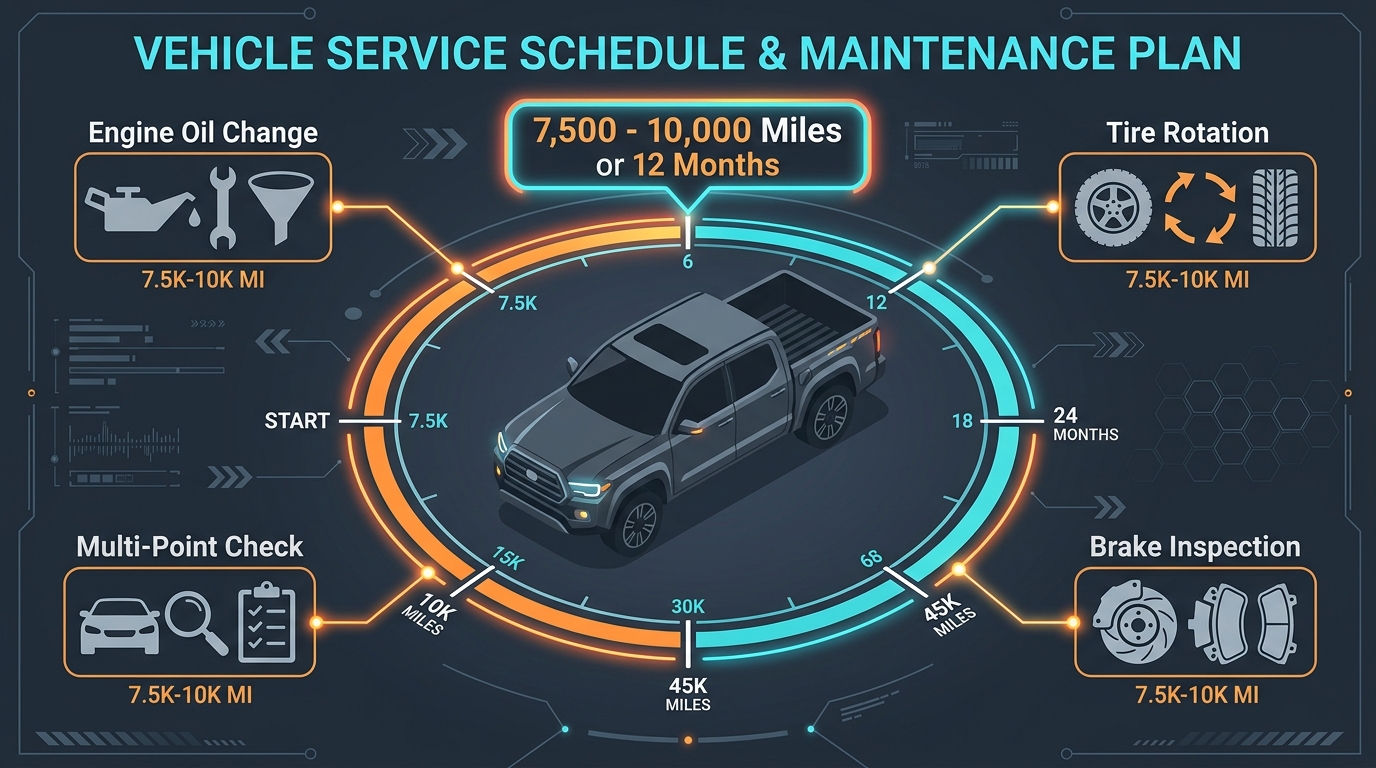
Ford recommends following the vehicle-specific Intelligent Oil-Life Monitor guidance system, which establishes routine service intervals between 7,500 to 10,000 miles or 12 months under normal driving conditions. This foundational service includes an engine oil and filter change, tire rotation, brake system inspection, and a multi-point health check.
Modern Ford engineering replaces generic mileage rules with sensor-driven algorithms. The Intelligent Oil-Life Monitor calculates oil degradation based on engine operating temperatures, towing strain, ambient weather, and idling time. Your instrument cluster provides clear alerts when service is needed, displaying 'Change Engine Oil Soon' at 5% remaining oil life and 'Oil Change Required' at 0%. Regardless of the monitor reading or accumulated mileage, engine oil must be changed at least once every 12 months to preserve internal engine components.
Tire care is directly synchronized with engine oil service. Rotating your tires at every oil change interval ensures even tread wear across all four positions, maximizing tire life and preserving all-wheel-drive differential components. For commuters traveling daily between work sites and rural routes around Tullahoma, sticking strictly to these display alerts prevents premature wear and maintains peak fuel efficiency.
Our service department relies directly on factory software to verify your system status and clear monitor indicators during scheduled maintenance. You can easily find our Shelbyville facility off the main highway, or give our service desk a quick call to verify your recommended upkeep timeline.
Table of Contents
- What Is the Official Maintenance Schedule for a 2026 Ford F-150?
- How Do Severe Driving Conditions Change Your Ford Maintenance Schedule?
- What Service Items Can Be Done DIY, and What Are Ford's Safety Guidelines?
- Which Ford Model Has the Lowest Long-Term Maintenance Cost?
- Is There an Extra Fee for Ford Mobile Service Convenience?
- Common Questions About Ford Maintenance and Service
- Maintain Peak Performance at Newton Ford South
What Is the Official Maintenance Schedule for a 2026 Ford F-150?
The official maintenance schedule for a 2026 Ford F-150 sets major service milestones at 7,500 to 10,000 miles for routine care, 20,000 miles for cabin air filter replacement, 30,000 miles for engine air filter service, 100,000 miles for spark plug replacement, and 200,000 miles for the initial engine coolant flush.
Truck owners who pull heavy trailers usually ask about rear axle fluid changes and brake pad wear before they check their oil monitor status. Routine maintenance on America's best-selling truck centers on protecting high-torque powertrains and heavy-duty drivetrain hardware:
- 7,500 to 10,000 Miles (or 12 Months): Synthetic blend motor oil change, oil filter replacement, tire rotation, battery terminal check, and comprehensive multi-point inspection of steering linkages, driveshafts, and brake pads.
- 20,000 Miles: Cabin air filter replacement to maintain clean interior ventilation and HVAC efficiency.
- 30,000 Miles: Engine air filter replacement to maintain optimal airflow and combustion efficiency in EcoBoost and V8 engines.
- 100,000 Miles: Spark plug replacement, accessory drive belt inspection, and automatic transmission fluid inspection.
- 200,000 Miles: First engine coolant flush and refill (subsequent coolant services occur every 100,000 miles or 5 years).
Whether your truck features traditional gas powertrains or specialized all-electric drivetrains, staying current on scheduled maintenance protects factory warranty coverage and long-term resale value. Drivers can easily schedule a service appointment online with our factory-trained technicians. If you are considering adding a new truck to your driveway, explore our new F-150 inventory or learn more about electric performance with our new F-150 Lightning models.
How Do Severe Driving Conditions Change Your Ford Maintenance Schedule?
Operating a Ford vehicle under severe driving conditions shortens service intervals to every 3,000 to 5,000 miles or 6 months for engine oil changes, tire rotations, and drivetrain fluid inspections. Severe operating conditions include frequent trailer towing, heavy payload hauling, extensive engine idling, driving in dusty or unpaved environments, and frequent short trips in extreme hot or cold temperatures.
Towing and heavy hauling force engine oil and transmission fluids to operate at elevated temperatures, which breaks down chemical additives faster than high-speed highway cruising. Under these working conditions, Ford recommends changing engine oil every 5,000 to 7,500 miles for moderate loads, and accelerating to 3,000 to 5,000 miles when operating at maximum gross vehicle weight ratings or in severe heat. Drivetrain components like front and rear differentials and transfer cases also require fluid changes earlier than standard schedules dictate.
Air filter monitoring becomes critical when traveling on unpaved roads. Dust and agricultural debris clog engine and cabin air filters rapidly, restricting intake airflow and straining climate control blowers. Drivers navigating livestock trailers through agricultural pastures near Shelbyville put heavy strain on transmission and brake components, requiring this accelerated timeline.
If you are currently evaluating working trucks or SUVs, browsing our certified pre-owned inventory provides access to well-maintained models with documented service histories.
What Service Items Can Be Done DIY, and What Are Ford's Safety Guidelines?
Basic DIY service items on a Ford include replacing engine and cabin air filters, inspecting battery terminals, topping off washer fluid, changing wiper blades, and setting correct tire pressures. However, For safety, never work underneath any vehicle supported solely by a hydraulic jack; use properly rated floor jack stands placed beneath approved axle or frame support points.
Simple filter replacements require no special mechanical tools and represent quick home upkeep tasks. Replacing an engine air filter involves releasing air box housing clamps, removing the old filter, wiping dirt from the housing base, and dropping in a new element. Cabin air filters are easily accessible behind the glove box compartment. Checking tire pressure monthly with a digital gauge prevents uneven tread wear and ensures optimal fuel efficiency.
When DIY care extends beneath the vehicle—such as during home oil changes—safety protocols are critical:
- Park on a level, concrete surface, set the parking brake firmly, and select Park or Neutral.
- Chock the wheels remaining on the ground to block vehicle movement completely.
- Use a hydraulic jack rated above the total weight of your vehicle applied exclusively to designated frame or axle lift points; never lift by the bumper or body panels.
- Position heavy-duty floor jack stands under the solid axles or main frame side-members, lowering the vehicle onto the stands before placing any part of your body underneath.
For drivers who prefer certified technicians to handle fluid drains and underbody work, our service team utilizes commercial vehicle lifts and specialized tools. You can also view our certified pre-owned vehicles to see models that have passed rigorous multi-point safety inspections.
Which Ford Model Has the Lowest Long-Term Maintenance Cost?
Compact trucks and crossover SUVs like the Ford Maverick and Ford Ranger deliver the lowest long-term maintenance costs across the Ford lineup due to smaller fluid capacities, efficient engine options, and lower replacement costs for wear items like tires and brake pads.
Smaller engine configurations require fewer quarts of motor oil per service visit, while lighter vehicle curb weights reduce overall stress on suspension bushings, shock absorbers, and braking hardware. Comparing maintenance shapes across vehicle sizes illustrates these differences:
| Vehicle Model | Engine Spec | Drivetrain | Towing Capacity | Seating |
|---|---|---|---|---|
| Ford Escape | 1.5L | All-wheel drive | 2,000 lbs | 5 |
| Ford Explorer | 2.3L | All-wheel drive | 5,000 lbs | 6 |
The Ford Escape, featuring a starting MSRP of $31,750 (excluding taxes, title, license, fees, and optional equipment), an 8-speed automatic transmission, and fuel economy ratings of 26 mpg city / 32 mpg highway, offers lightweight vehicle dynamics that keep routine tire and brake replacement costs remarkably low. By contrast, a larger three-row vehicle like the Ford Explorer, with a starting MSRP of $42,585, a SelectShift® transmission, ratings of 20 mpg city / 27 mpg highway, and 5,000 lbs towing capability, utilizes larger brake rotors and heavy-duty tires designed for higher vehicle mass.
Shoppers looking to minimize ownership costs can explore our new vehicle lineup to compare models, and quickly evaluate your trade-in online to calculate total cost-of-ownership savings.
Is There an Extra Fee for Ford Mobile Service Convenience?
Ford Mobile Service is provided by participating dealerships without additional convenience surcharges, offering routine maintenance items at pricing comparable to our dealership service bays.
Mobile Service vans are outfitted with specialized machinery, compressed air lines, and diagnostic tools operated by factory-certified technicians. Services performed right in your home driveway or office parking lot include:
- Engine oil and filter changes
- Tire rotations and pressure adjustments
- Battery testing and replacement
- Cabin and engine air filter replacements
- Brake inspections and fluid top-offs
- Factory recall software updates and diagnostic checks
Eliminating the need to drive to the dealership or sit in a waiting room saves time for busy professionals and families. Maintenance charges, parts pricing, and promotional offers apply identically whether service occurs in our facility or at your location. If you are planning your next vehicle purchase alongside your routine care, you can apply for financing online to complete your paperwork before visiting.
Common Questions About Ford Maintenance and Service
Q: How does the Ford Intelligent Oil-Life Monitor determine when an oil change is needed?
The Intelligent Oil-Life Monitor uses onboard computer algorithms to analyze engine operating conditions rather than counting plain mileage. It measures oil temperature, engine revolutions, towing frequency, cold-start counts, and idle time. When remaining oil life reaches 5%, the display alerts 'Change Engine Oil Soon'. At 0%, it displays 'Oil Change Required'. Oil must be serviced whenever indicated, or at least once every 12 months.
Q: What is the spark plug replacement interval for Ford EcoBoost engines?
Under normal driving conditions, Ford specifies spark plug replacement at 100,000 miles for EcoBoost and traditional V8 gasoline engines. However, if you frequently tow heavy trailers or operate under severe driving conditions, inspecting and replacing spark plugs earlier helps prevent engine misfires and maintains smooth idle quality.
Q: Does mild seasonal weather impact battery maintenance on Ford vehicles?
Mild seasonal shifts reduce extreme battery stress compared to freezing northern regions, but heat and humidity still accelerate internal battery plate corrosion. Testing your 12-volt battery during routine 10,000-mile service visits ensures adequate cold-cranking amps before battery performance degrades.
Q: What warranty coverage applies to Motorcraft replacement parts purchased during service?
Genuine Motorcraft service parts installed during scheduled maintenance carry a 24-month/unlimited-mileage limited warranty that includes both part coverage and labor when installed at an authorized service center. Wear items like wiper blades and brake pads may have separate coverage details depending on the part and warranty terms.
Learn more about our technician certifications by reading about our dealership team, or order genuine Motorcraft parts online for your upkeep needs.
Maintain Peak Performance at Newton Ford South
Adhering to your factory-recommended maintenance schedule is the single best way to maximize vehicle reliability, fuel efficiency, and long-term resale value. Whether your instrument cluster just signaled an oil change alert or your truck is due for its 100,000-mile major service, relying on factory-trained technicians ensures your powertrain receives genuine Motorcraft fluids and engineered parts built specifically for your vehicle.
Our service center makes maintaining your vehicle simple, efficient, and transparent. Stop by our service center in Shelbyville today for a full multi-point inspection, or give our advisors a quick call to book your next appointment.
© 2026 Newton Ford South. All rights reserved.