How Do You Calculate Total Gross Trailer Weight Including Equipment?
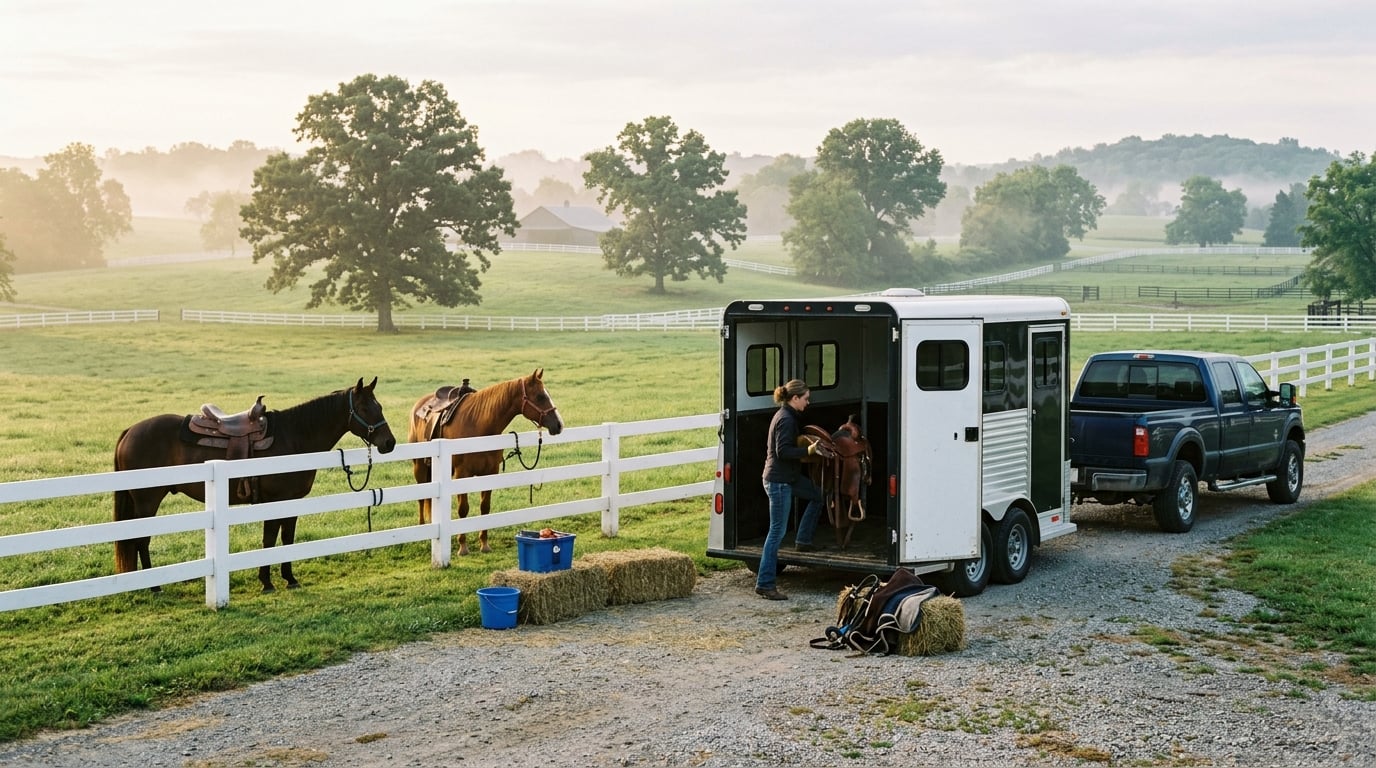
To calculate total gross trailer weight including equipment, add the unladen dry weight of the empty trailer to the combined weight of all horses, full water tanks, tack, saddles, hay bales, portable stalls, and extra gear. For an average two-horse setup, this means taking a 3,000-pound empty trailer and adding two 1,100-pound Tennessee Walking Horses plus 800 pounds of gear and water, resulting in a total gross trailer weight of 6,000 pounds.
Determining an exact gross trailer weight requires accounting for every item placed inside or mounted onto the trailer structure. Dry trailer weight reflects only the bare frame and shell as delivered from the manufacturer. Equine transport loads vary significantly based on the size and breed of the horses. An adult Tennessee Walking Horse typically weighs between 900 and 1,200 pounds. When loading two mature horses, horse weight alone contributes 1,800 to 2,400 pounds to the total trailer load.
Equipping a trailer for an event demands additional cargo weight planning. A full 30-gallon onboard water tank adds roughly 250 pounds. Leather saddles, bridles, blankets, grooming kits, and steel portable stall panels frequently add another 300 to 500 pounds. Heavy square hay bales add 40 to 60 pounds each. Taking your loaded trailer to a certified public vehicle scale provides the most accurate weight measurement before heading onto highway routes.
Safety regulations in Tennessee set strict mechanical requirements based on gross trailer weight. According to TN.gov Trailer Inspection Requirements, trailers with a gross weight of 3,000 pounds or more must feature operational brakes on all wheels, whereas trailers weighing between 1,500 and 3,000 pounds require brakes on at least one axle. State regulations also require at least two rear tail lamps, two rear stop lamps, two rear turn signal lamps, and two rear reflectors. Trailers measuring 80 inches wide or greater must carry side marker lamps and clearance lamps, and trailers exceeding 32 feet in length require intermediate reflectors. If you need help reviewing your tow setup specs or checking your hitch equipment, feel free to give our team (931) 536-4424 or stop by our showroom location.
Table of Contents
- What Towing Capacity Is Required for a 2-Horse Bumper Pull Trailer?
- Can a Half-Ton Ford Pickup Safely Tow Tennessee Walking Horses?
- What Truck Specs Are Recommended for Towing a 4-Horse Gooseneck Trailer to Shelbyville?
- Do You Need a Dually Truck and Specific Axle Ratios for Heavy Gooseneck Trailers?
- Frequently Asked Questions About Safe Trailering for the Tennessee Walking Horse Celebration
- Preparing Your Towing Setup
What Towing Capacity Is Required for a 2-Horse Bumper Pull Trailer?
Safe transport for a fully loaded two-horse bumper pull trailer requires a tow vehicle rated for at least 8,500 to 10,000 pounds of towing capacity. While a loaded two-horse trailer housing two Tennessee Walking Horses, tack, and water typically weighs between 5,000 and 7,500 pounds, maintaining a safety margin prevents excessive mechanical strain on engine and braking components.
Empty two-horse bumper pull trailers generally weigh between 2,400 and 3,500 pounds depending on whether the frame uses steel or aluminum construction. Aluminum models offer lighter unladen weights, whereas steel trailers provide rugged durability at a higher base mass. When you load two 1,100-pound horses along with 500 pounds of tack, feeds, and fluids, a 3,000-pound aluminum trailer quickly reaches a total operating weight of 5,700 pounds, while a steel trailer setup easily pushes past 6,500 pounds.
Equine enthusiasts transporting stock across the rolling hills surrounding Tullahoma benefit from extra towing capacity buffer when climbing elevated country grades. Pushing a tow vehicle to its absolute maximum tow limit creates drivetrain heat and compromises emergency handling stability. Operating with a 2,000-pound buffer between your loaded trailer weight and your vehicle's maximum tow rating ensures smoother acceleration, reduced brake wear, and better control during unexpected sudden stops.
Matching the braking system of the tow vehicle and trailer is equally critical. Ford’s 2026 RV and Trailer Towing Guide notes that the tow vehicle’s primary braking system is rated strictly for the truck’s Gross Vehicle Weight Rating (GVWR), not its Gross Combined Weight Rating (GCWR). This engineering principle highlights why relying solely on truck brakes to stop a heavy horse trailer is unsafe. To explore properly equipped tow vehicles, browse our brand-new Ford truck lineup or consult with our Ford parts department about factory brake controllers and weight-distributing hitches.
Can a Half-Ton Ford Pickup Safely Tow Tennessee Walking Horses?
A modern half-ton Ford F-150 equipped with a factory trailer tow package can safely tow a two-horse bumper pull trailer containing Tennessee Walking Horses, provided payload and tongue weight limits are strictly observed. Proper vehicle configuration ensures the truck stays within its rear axle weight ratings when carrying passengers, tack, and hitch load simultaneously.
Bumper pull trailers place 10% to 15% of their total gross weight directly onto the truck's receiver hitch ball as tongue weight. For a 7,000-pound loaded two-horse trailer, the hitch receives between 700 and 1,050 pounds of downward tongue load. That downward force counts directly against the truck's available payload capacity. If your half-ton pickup has a total payload capacity of 1,800 pounds, subtracting a 900-pound tongue weight leaves 900 pounds for driver, passengers, bed cargo, and mounted accessories.
By comparison, smaller utility vehicles lack the chassis mass and axle ratings required for multi-horse hauling. A current 2026 Ford Explorer carries a maximum towing rating up to 5,000 pounds, which can accommodate light utility loads or single small livestock setups but lacks the capacity for a loaded two-horse trailer. A midsize 2026 Ranger equipped with the Advanced Towing Package includes an Integrated Trailer Brake Controller on XLT and Lariat trims, providing capable towing for light recreational loads. However, the full-size F-150 remains the ideal minimum baseline for two-horse transport due to its wider track, longer wheelbase, and higher axle ratings.
Evaluating real-world vehicle weight ratings requires checking the specific tire and loading information decal located on the driver door pillar. Drivers upgrading their tow vehicle can inspect our pre-owned vehicle inventory to compare half-ton truck configurations with varying bed lengths and axle ratios.
What Truck Specs Are Recommended for Towing a 4-Horse Gooseneck Trailer to Shelbyville?
Safely pulling a loaded four-horse gooseneck trailer requires a three-quarter-ton or one-ton heavy-duty truck with a conventional towing rating of at least 15,000 to 20,000 pounds and a payload capacity exceeding 3,000 pounds. Fully loaded four-horse gooseneck trailers with living quarters generally weigh between 12,000 and 18,000 pounds, requiring a robust chassis and high rear-axle capacity.
Gooseneck trailer hitches connect to a ball mounted directly inside the truck bed over or slightly ahead of the rear axle. This design transfers roughly 20% to 25% of the total trailer weight onto the truck chassis as pin weight. On a 16,000-pound four-horse trailer with living quarters, water tanks, and full event gear, the pin weight exerts 3,200 to 4,000 pounds of direct downward force onto the bed. Half-ton trucks lack the payload ratings to support this weight, making three-quarter-ton F-250 or one-ton F-350 trucks mandatory.
Wheelbase length plays a vital role in directional control when hauling long gooseneck structures. Crew cab long bed configurations provide an extended wheelbase that stabilizes the truck against side-wind forces and trailer sway during highway travel. The additional distance between the front and rear axles prevents the trailer pin weight from lifting or unweighting the front steering axle, preserving positive steering feedback and headlight alignment.
When local horse owners walk around a Super Duty on our lot, they usually check the payload rating sticker on the driver door jamb before looking at anything else. Verifying these door jamb specifications ensures the truck legal limits match your trailer pin weight. To find trucks equipped for heavy gooseneck hauling, take a look at our certified pre-owned Ford selection.
Do You Need a Dually Truck and Specific Axle Ratios for Heavy Gooseneck Trailers?
A dual rear wheel (dually) truck is recommended for gooseneck trailers exceeding 14,000 pounds because four rear tires provide superior lateral stability and higher rear axle weight ratings against heavy pin weight. For climbing highway grades with heavy livestock loads, rear axle ratios between 3.73:1 and 4.10:1 deliver the necessary low-end pulling power.
Single rear wheel 3500-class trucks can manage lighter gooseneck trailers, but a dually configuration offers significant safety advantages when transporting live animals. Horses move around during transit, shifting the trailer center of gravity unpredictably. Dual rear wheels widen the rear stance of the tow vehicle, drastically reducing body roll, tire deflection, and lateral sway caused by shifting horse weight or sudden crosswinds.
Selecting the proper rear axle ratio determines how efficiently your engine converts horsepower into low-speed pulling torque. Axle ratios such as 3.73:1 or 4.10:1 allow the engine to operate in its optimal power band when launching heavy loads from a stop or pulling steep terrain. These lower gear ratios reduce torque converter heat build-up inside the automatic transmission during sustained climbs.
Integrated trailer control technology further enhances towing security. Ford’s Integrated Trailer Brake Controller automatically applies the trailer brakes in proportion to the tow vehicle's deceleration rate. This electronic system coordinates electric or electric-over-hydraulic trailer brakes, eliminating push-pull motion between truck and trailer. Drivers preparing their trucks for heavy trailering duty can schedule a service appointment to inspect hitch mounts, electrical connectors, and brake systems.
Frequently Asked Questions About Safe Trailering for the Tennessee Walking Horse Celebration
Q: What is the average weight of an adult Tennessee Walking Horse?
An adult Tennessee Walking Horse generally weighs between 900 and 1,200 pounds. When calculating total hauling weight, use the upper end of this range for each mature horse to ensure a safety cushion for feeding, tack, and water onboard.
Q: How much payload capacity does a gooseneck horse trailer consume?
A gooseneck horse trailer places roughly 20% to 25% of its total gross weight onto the truck bed as pin weight. For a 14,000-pound loaded trailer, this puts 2,800 to 3,500 pounds of direct load on the rear axle, which must fit within the truck's posted payload and Gross Vehicle Weight Rating.
Q: Are trailer brakes legally required for horse trailers in Tennessee?
Yes, Tennessee law mandates that any trailer with a gross weight of 3,000 pounds or more must feature operational brakes on all wheels. Trailers weighing between 1,500 and 3,000 pounds require brakes on at least one axle, making functioning trailer brakes mandatory for virtually all horse trailers.
Q: What safety lighting is required on horse trailers in Tennessee?
Tennessee state rules require horse trailers to carry at least two red tail lamps, two red stop lamps, two red turn signals, and two red rear reflectors visible from behind. Trailers measuring 80 inches or wider must also feature side marker and clearance lamps.
Q: How does tongue weight differ between bumper pull and gooseneck trailers?
Bumper pull trailers transfer 10% to 15% of their total gross weight to the hitch ball behind the rear bumper. Gooseneck trailers transfer 20% to 25% of their total weight directly over the rear axle, improving tow stability while demanding higher truck payload capacity.
To review your trailering needs with our experienced team, learn more about our dealership team or start evaluating your current truck by using our tool to value your current vehicle trade in online.
Preparing Your Towing Setup
Ensuring a safe towing setup begins with verifying that your truck's payload capacity, Gross Vehicle Weight Rating, and rear axle ratings comfortably match your loaded horse trailer. Matching your hitch setup, brake controller, and cooling systems to your specific horse transport needs guarantees steady performance on every journey.
Our team at Newton Ford South is ready to assist you in selecting the right truck, inspecting towing equipment, and configuring your setup for safe trailering. You can apply for Ford financing online to explore vehicle options, give us a call at (931) 536-4424 with any questions, or visit our dealership at 2811 US, Shelbyville, TN 37160 to get started.