What Are the Key Specs and Features of the 2026 Ford Explorer?
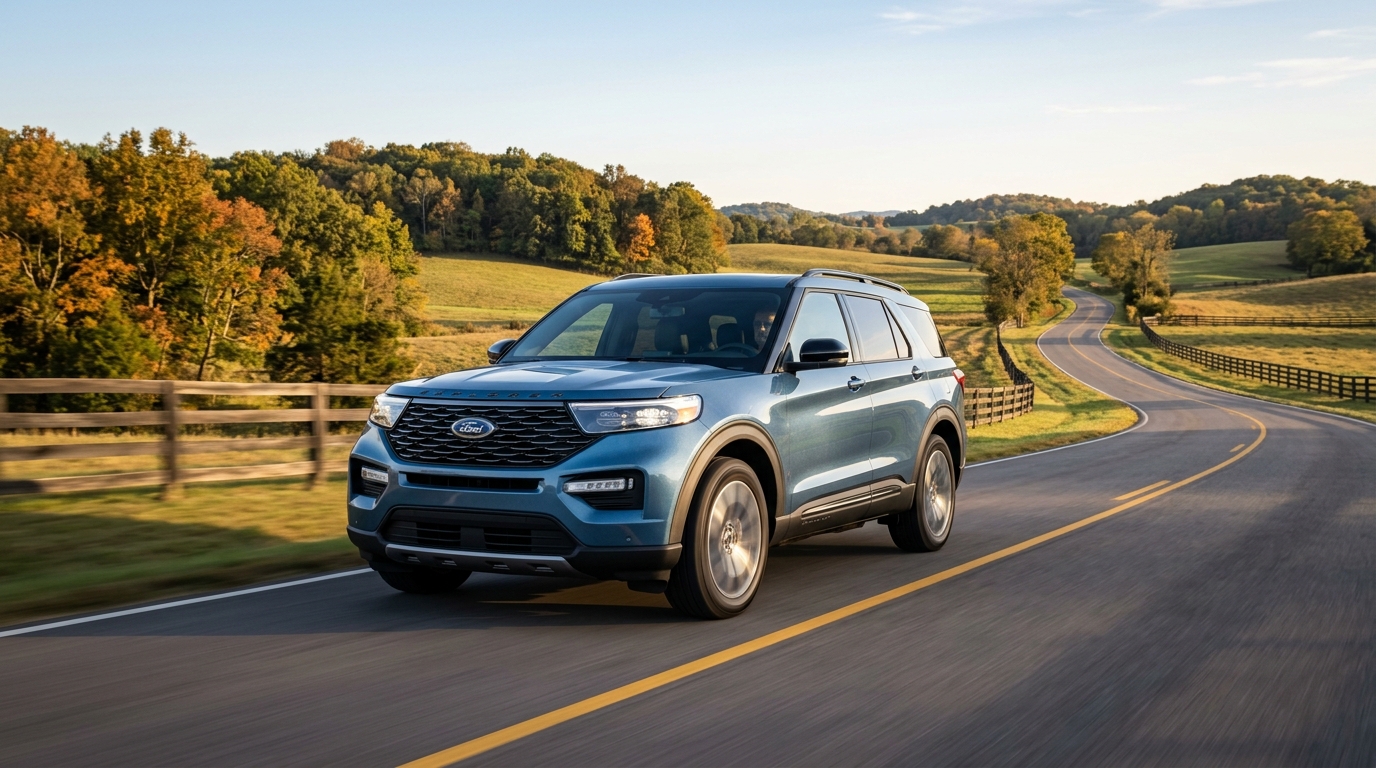
The 2026 Ford Explorer comes standard with a 300-hp 2.3L EcoBoost I-4 engine or an available 400-hp 3.0L EcoBoost V6, paired with a SelectShift® 10-speed automatic transmission. Built on a rear-wheel-biased architecture measuring 199 inches in length on a 119-inch wheelbase, it offers up to 5,000 lbs of maximum towing capacity, an EPA-estimated fuel economy up to 20 city / 29 hwy MPG, up to 86 cubic feet of total cargo space, and standard Ford Co-Pilot360 driver-assist tech.
Inside the cabin, seating layouts support six or seven passengers depending on whether you choose second-row captain's chairs or a 60/40 split bench seat. Drivers are greeted by a standard 13-inch center touchscreen running wireless Apple CarPlay® and Android Auto™, alongside a 12-inch digital instrument panel. Flexible cargo options provide roughly 16 cubic feet of storage behind the third row, which expands to 46 cubic feet with the third row folded down.
For suburban families around Spring Hill who need a capable vehicle for daily school routes and weekend highway travel, the chassis delivers car-like composure without compromising SUV versatility. Standard active safety technology includes blind-spot monitoring with rear cross-traffic alert, lane-keeping assist, and automatic emergency braking. To view current availability in person or take a test drive, visit our Shelbyville showroom address or give our team a call at (931) 536-4424 to speak with a specialist.
Table of Contents
- What Engine Options and Powertrain Specs Power Recent Ford Explorers?
- How Much Does a New Ford Explorer Cost Across Each Trim Level?
- What Towing Capacity and Off-Road Capabilities Does the Explorer Offer?
- Which SUV Delivers Better Third-Row Legroom: Explorer or Highlander?
- Which Used Ford Explorer Model Years Offer the Best Value and Selection?
- Frequently Asked Purchasing Questions About the Ford Explorer
- How Long Does Custom Ordering Take?
What Engine Options and Powertrain Specs Power Recent Ford Explorers?
Recent Ford Explorer models feature two core EcoBoost powertrains: a standard 2.3L EcoBoost I-4 delivering 300 hp and 310 lb-ft of torque, and an available twin-turbocharged 3.0L EcoBoost V6 pushing 400 hp and 415 lb-ft of torque. Both engines link to a SelectShift® 10-speed automatic transmission available in rear-wheel drive or Intelligent 4WD.
The standard turbocharged 2.3-liter four-cylinder balances brisk low-end acceleration with highway efficiency. Rear-wheel drive configurations like the Active RWD reach EPA estimates of 20 city / 29 hwy MPG, while four-wheel-drive variants maintain an EPA-estimated 20 city / 27 hwy MPG. Direct injection and twin-scroll turbocharging help this four-cylinder engine perform with the punch of a traditional V6 while minimizing fuel consumption.
For maximum power, the twin-turbo 3.0-liter V6 serves as standard equipment on performance-focused builds like the ST and premium models like the Platinum. This engine generates quick highway merging power and confident hill-climbing power under heavy load. Drivers researching certified pre-owned Ford options may also encounter fleet-oriented models like the Utility Police Interceptor, which offered a 3.3L V6 hybrid powertrain producing 318 hp and 260 lb-ft of torque.
Engine & Performance
Powertrain specs by trim
| Feature | Active 4WD | Active 4WD 100A | Active RWD | Active RWD 100A | Platinum | Platinum 4WD | ST | ST 4WD | ST-LINE 4WD | ST-LINE RWD | Tremor 4WD | Utility Police Interceptor 4x4 |
|---|---|---|---|---|---|---|---|---|---|---|---|---|
| :-- | :-- | :-- | :-- | :-- | :-- | :-- | :-- | :-- | :-- | :-- | :-- | :-- |
| Engine | 2.3L | 2.3L | 2.3L | 2.3L | 2.3L | 2.3L | 3L | 3L | 2.3L | 2.3L | 2.3L | 3.3L |
| Horsepower | 300 hp | 300 hp | 300 hp | 300 hp | 300 hp | 300 hp | 400 hp | 400 hp | 300 hp | 300 hp | 300 hp | 318 hp |
| Torque | 310 lb-ft | 310 lb-ft | 310 lb-ft | 310 lb-ft | 310 lb-ft | 310 lb-ft | 415 lb-ft | 415 lb-ft | 310 lb-ft | 310 lb-ft | 310 lb-ft | 260 lb-ft |
| Transmission | SelectShift® | SelectShift® | SelectShift® | SelectShift® | SelectShift® | SelectShift® | SelectShift® | SelectShift® | SelectShift® | SelectShift® | SelectShift® | SelectShift |
| Drivetrain | All-wheel drive | All-wheel drive | Rear-wheel drive | Rear-wheel drive | Rear-wheel drive | All-wheel drive | Rear-wheel drive | All-wheel drive | All-wheel drive | Rear-wheel drive | All-wheel drive | All-wheel drive |
How Much Does a New Ford Explorer Cost Across Each Trim Level?
Pricing for the 2026 Ford Explorer starts at an entry MSRP of $38,465 for the Active RWD 100A trim and reaches $56,905 for the range-topping ST 4WD, with a standard $1,795 destination fee across non-commercial trims. A well-structured lineup allows buyers to balance comfort features, styling accents, and performance capabilities.
Entry-level trims deliver strong value for family buyers. The standard Active RWD carries a base MSRP of $40,585 ($42,585 for Active 4WD), adding refined interior upgrades over the entry package. Upgrading to the sport-styled ST-Line RWD brings a starting price of $45,155 MSRP ($47,155 for ST-Line 4WD), introducing dark exterior trim, red interior stitching, and 20-inch wheels.
Rugged and luxury options occupy the top tier of the range. The off-road-focused Tremor 4WD begins at $48,965 MSRP, featuring raised suspension and all-terrain hardware. Premium buyers reviewing our new Ford Explorer inventory can examine the Platinum RWD at $50,965 MSRP ($52,965 for Platinum 4WD), while performance enthusiasts can explore our full new vehicle lineup to experience the ST RWD starting at $54,905 MSRP. Scheduling regular vehicle maintenance through our service scheduling tool preserves the resale value of any trim level over time.
Pricing
Pricing by trim
| Feature | Active 4WD | Active 4WD 100A | Active RWD | Active RWD 100A | Platinum | Platinum 4WD | ST | ST 4WD | ST-LINE 4WD | ST-LINE RWD | Tremor 4WD | Utility Police Interceptor 4x4 |
|---|---|---|---|---|---|---|---|---|---|---|---|---|
| :-- | :-- | :-- | :-- | :-- | :-- | :-- | :-- | :-- | :-- | :-- | :-- | :-- |
| Base MSRP | $42,585 | $40,465 | $40,585 | $38,465 | $50,965 | $52,965 | $54,905 | $56,905 | $47,155 | $45,155 | $48,965 | $48,550 |
| Destination charge | $1,795 | $1,795 | $1,795 | $1,795 | $1,795 | $1,795 | $1,795 | $1,795 | $1,795 | $1,795 | $1,795 | $1,695 |
What Towing Capacity and Off-Road Capabilities Does the Explorer Offer?
Every 2026 Ford Explorer comes equipped with the Class III Trailer Tow Package, rating the vehicle to pull a maximum towing capacity of up to 5,000 lbs. Off-road hardware reaches its peak on the Tremor 4WD trim, which features a factory one-inch suspension lift, steel underbody skid plates, all-terrain tires, and a Torsen® limited-slip rear differential.
Towing stability is enhanced by the platform's rear-wheel-drive architecture, which naturally puts weight over the driving wheels when pulling a trailer. Standard trailer sway control continuously adjusts engine throttle and selective wheel braking to keep trailing loads stable on highway drives. For drivers hauling fishing boats or camper trailers across rural routes in Bedford County, this powertrain setup makes boat ramp launches and highway towing straightforward.
Off-road traction relies on an Intelligent 4WD system paired with Ford's Terrain Management System, offering selectable drive modes for Sand, Mud/Ruts, Slippery, Tow/Haul, and Eco. The Tremor trim maximizes ground clearance and underbody protection, giving trail enthusiasts the capability to handle unpaved back roads with ease. Buyers planning their next adventure vehicle can start by applying for financing online to contact our team for current financing information before finalizing their specification.
Dimensions & Capacity
Capacity and dimensions by trim
| Feature | Active 4WD | Active 4WD 100A | Active RWD | Active RWD 100A | Platinum | Platinum 4WD | ST | ST 4WD | ST-LINE 4WD | ST-LINE RWD | Tremor 4WD | Utility Police Interceptor 4x4 |
|---|---|---|---|---|---|---|---|---|---|---|---|---|
| :-- | :-- | :-- | :-- | :-- | :-- | :-- | :-- | :-- | :-- | :-- | :-- | :-- |
| Seating | 6 | 6 | 6 | 6 | 6 | 6 | 6 | 6 | 7 | 7 | 6 | 7 |
| Cargo | 16.3 cu ft | 16.3 cu ft | 16.3 cu ft | 16.3 cu ft | 16.3 cu ft | 16.3 cu ft | 16.3 cu ft | 16.3 cu ft | 16.3 cu ft | 16.3 cu ft | 16.3 cu ft | 52.0 cu ft |
| Curb weight | 4,303 lbs | 4,303 lbs | 4,303 lbs | 4,303 lbs | 4,303 lbs | 4,303 lbs | 4,631 lbs | 4,631 lbs | 4,303 lbs | 4,303 lbs | 4,424 lbs | 4,732 lbs |
| Towing | 5,000 lbs | 5,000 lbs | 5,000 lbs | 5,000 lbs | 5,000 lbs | 5,000 lbs | 5,000 lbs | 5,000 lbs | 5,000 lbs | 5,000 lbs | 5,000 lbs | 3,500 lbs |
| Payload | 1,467 lbs | 1,467 lbs | 1,467 lbs | 1,467 lbs | 1,467 lbs | 1,467 lbs | 1,139 lbs | 1,139 lbs | 1,467 lbs | 1,467 lbs | 1,346 lbs | 2,108 lbs |
Which SUV Delivers Better Third-Row Legroom: Explorer or Highlander?
The Ford Explorer provides 32 inches of third-row legroom, comfortably topping the Toyota Highlander's 28 inches of rear legroom. That four-inch difference gives the Explorer a major advantage when carrying teenagers or adults in the rearmost row.
Passenger comfort in the third row depends heavily on vehicle architecture. The rear-drive platform of the Explorer creates a wider cabin floor pan, allowing third-row passengers to sit with a more natural knee angle. When families test-drive vehicles on our lot, they notice how the EZ Entry second-row captain's chairs slide and pitch forward with a single handle release, creating a wide entryway even when child safety seats remain installed in the second row.
By contrast, the Toyota Highlander's tighter rear quarter limits third-row seating primarily to small children on short drives. Rear cargo capacity with all seats up also favors the Explorer, providing about 16 cubic feet of space for groceries and sports gear. Owners who want to optimize their cargo management can order fitted interior liners and utility accessories directly through our Ford parts department.
Which Used Ford Explorer Model Years Offer the Best Value and Selection?
Pre-owned Ford Explorer model years from 2021 through 2023 represent the strong option for value, combining the sixth-generation rear-drive platform with reasonable used-market pricing. Thousands of late-model Explorers populate nationwide inventories, providing buyers a broad selection of trims and mileage ranges.
Selecting a 2021 or newer pre-owned model ensures you get updated infotainment hardware, refined 10-speed transmission software, and standard Ford Co-Pilot360 driver assists while skipping initial first-year model depreciation. Market averages vary by mileage, trim, and condition, offering notable differences compared to new vehicle pricing.
Shoppers seeking even lower price points can look at late fifth-generation models from 2017 to 2018, which vary by condition, mileage, and trim and carry a track record of reliable service. Buyers evaluating our pre-owned vehicle selection can browse pre-inspected inventory online, and customers planning a vehicle upgrade can value their trade-in online to estimate their current vehicle's worth.
Frequently Asked Purchasing Questions About the Ford Explorer
Q: What warranty coverage comes with a new Ford Explorer?
A: Every new 2026 Ford Explorer features Ford's standard new-vehicle factory protection, which includes a 3-year/36,000-mile bumper-to-bumper limited warranty alongside a 5-year/60,000-mile powertrain limited warranty. Ford also includes 5 years or 60,000 miles of complimentary roadside assistance for added peace of mind.
Q: What is the difference between standard Rear-Wheel Drive and Intelligent 4WD on the Explorer?
A: Standard rear-wheel drive directs power exclusively to the rear axle, delivering balanced weight distribution, sharp steering control, and maximum fuel efficiency. Intelligent 4WD monitors wheel speed and road conditions constantly, automatically transferring power to front wheels with traction while unlocking selectable Terrain Management drive modes for snow, mud, and sand.
Q: Is the 2.3L EcoBoost engine strong enough for towing heavy loads?
A: Yes, the 2.3L EcoBoost I-4 engine generates 300 hp and 310 lb-ft of torque. When equipped with the standard Class III Trailer Tow Package, four-cylinder Explorer models achieve the full 5,000 lbs maximum towing capacity, making it fully capable of pulling boats, campers, and utility trailers.
Q: How does Ford Roadside Assistance assist drivers during breakdown emergencies?
A: Included with new vehicle ownership for five years or 60,000 miles, roadside protection covers flat tire changes, emergency fuel delivery, winching, and lockout services. If mechanical issues occur, drivers can call Ford Roadside Assistance: (800) 241-3673 to arrange direct vehicle transport to an authorized Ford dealership service bay using genuine factory replacement parts.
Q: How can I learn more about purchasing options at Newton Ford South?
A: Shoppers interested in reviewing current inventory, test-drive options, or financing plans can discover our dealership story and customer commitment online or connect directly with our sales team.
How Long Does Custom Ordering Take?
Custom ordering a new Ford Explorer directly from the assembly plant generally takes 8 to 12 weeks from order confirmation to final vehicle delivery. Lead times depend on total factory build schedules, selected trim specifications, and optional package choices.
Submitting a factory custom order ensures you get your exact choice of exterior paint color, seating layout, powertrain, and interior options without paying for feature packages you do not want. Once an order is accepted by the factory, a dedicated VIN and order number allow our team to track your vehicle through assembly, body shop inspection, and final transit rail delivery.
To begin configuring a factory order or to explore Explorer inventory currently scheduled for delivery, visit our Shelbyville showroom address at 2811 US, Shelbyville, TN 37160. You can also give our team a quick call to verify upcoming production allocations and check current availability.
© 2026 Newton Ford South. All rights reserved.